
Structure preservation via the Wasserstein distance
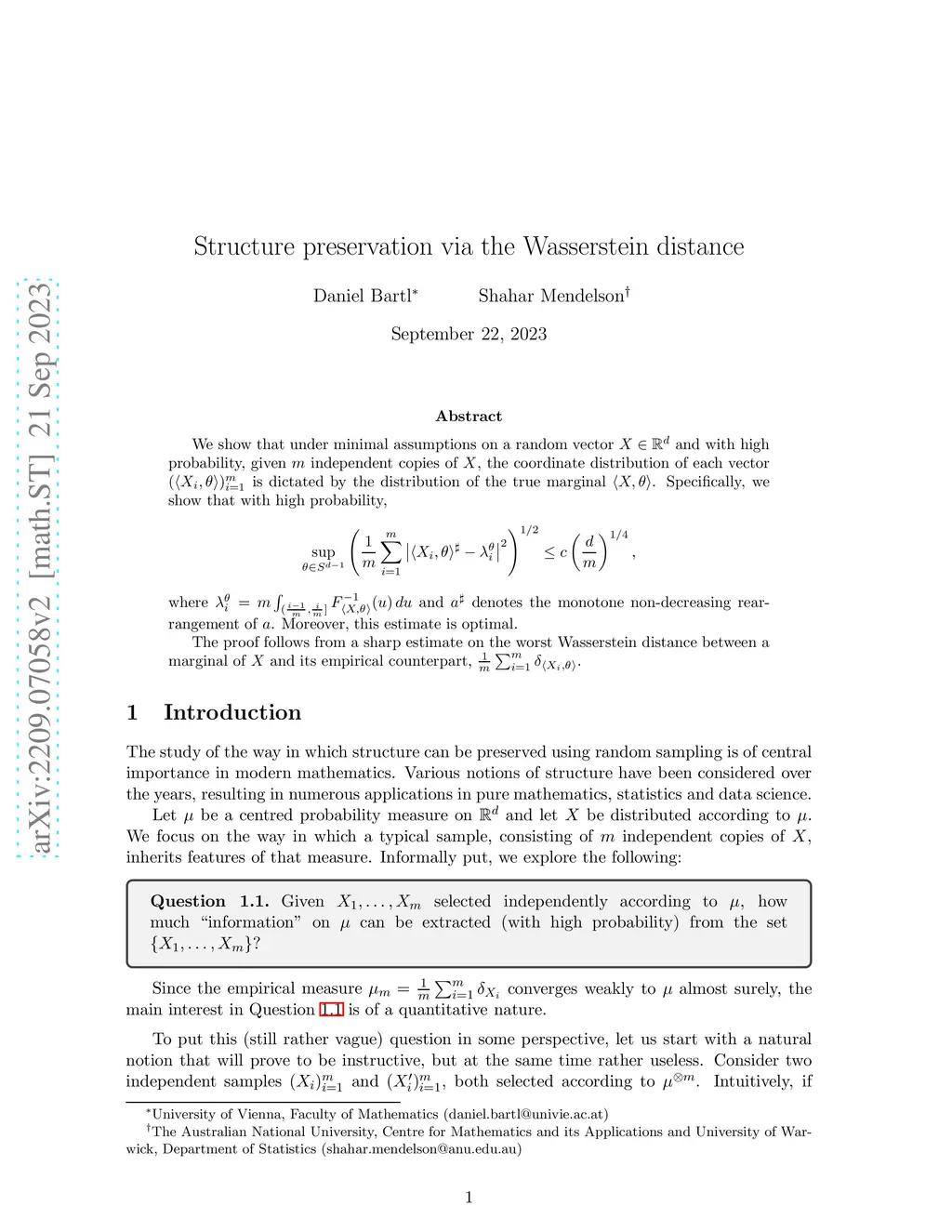
We show that under minimal assumptions on a random vector , and with high probability, given independent copies of , the coordinate distribution of each vector is dictated by the distribution of the true marginal . Formally, we show that with high probability, \[\sup_{\theta \in S^{d-1}} \left( \frac{1}{m}\sum_{i=1}^m \left|\langle X_i,\theta \rangle^\sharp - \lambda^\theta_i \right|^2 \right)^{1/2} \leq c \left( \frac{d}{m} \right)^{1/4},\] where and denotes the monotone non-decreasing rearrangement of . The proof follows from the optimal estimate on the worst Wasserstein distance between a marginal of and its empirical counterpart, . We then use the accurate information on the structures of the vectors to construct the first non-gaussian ensemble that yields the optimal estimate in the Dvoretzky-Milman Theorem: the ensemble exhibits almost Euclidean sections in arbitrary normed spaces of the same dimension as the gaussian embedding -- despite being very far from gaussian (in fact, it happens to be heavy-tailed).
View on arXiv