
Semi-autonomous Prosthesis Control Using Minimal Depth Information and Vibrotactile Feedback
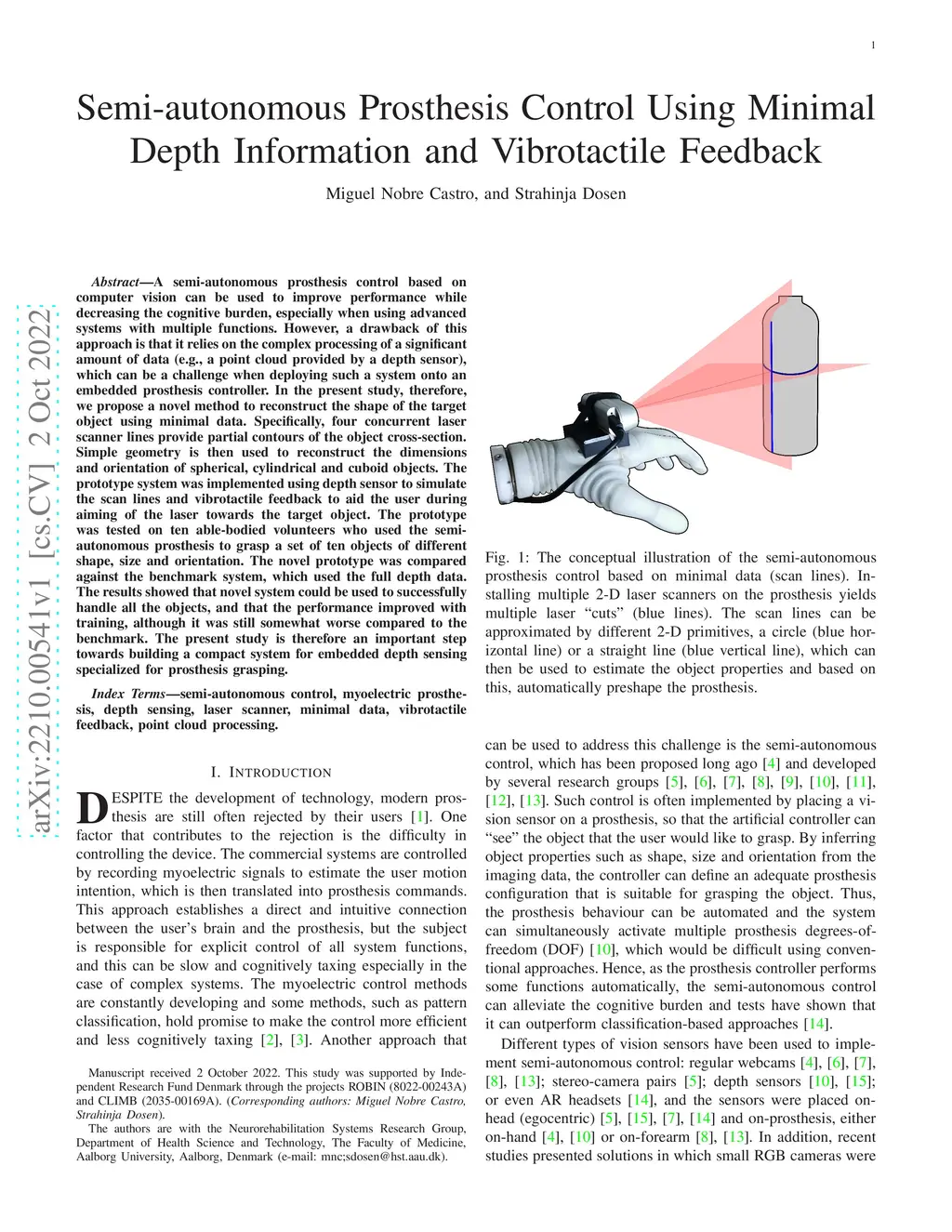
Semi-autonomous prosthesis controllers based on computer vision improve performance while reducing cognitive effort. However, controllers relying on full-depth data face challenges in being deployed as embedded prosthesis controllers due to the computational demands of processing point clouds. To address this, the present study proposes a method to reconstruct the shape of various daily objects from minimal depth data. This is achieved using four concurrent laser scanner lines instead of a full point cloud. These lines represent the partial contours of an object's cross-section, enabling its dimensions and orientation to be reconstructed using simple geometry. A control prototype was implemented using a depth sensor with four laser scanners. Vibrotactile feedback was also designed to help users to correctly aim the sensor at target objects. Ten able-bodied volunteers used a prosthesis equipped with the novel controller to grasp ten objects of varying shapes, sizes, and orientations. For comparison, they also tested an existing benchmark controller that used full-depth information. The results showed that the novel controller handled all objects and, while performance improved with training, it remained slightly below that of the benchmark. This marks an important step towards a compact vision-based system for embedded depth sensing in prosthesis grasping.
View on arXiv