
TAPS: Task-Agnostic Policy Sequencing
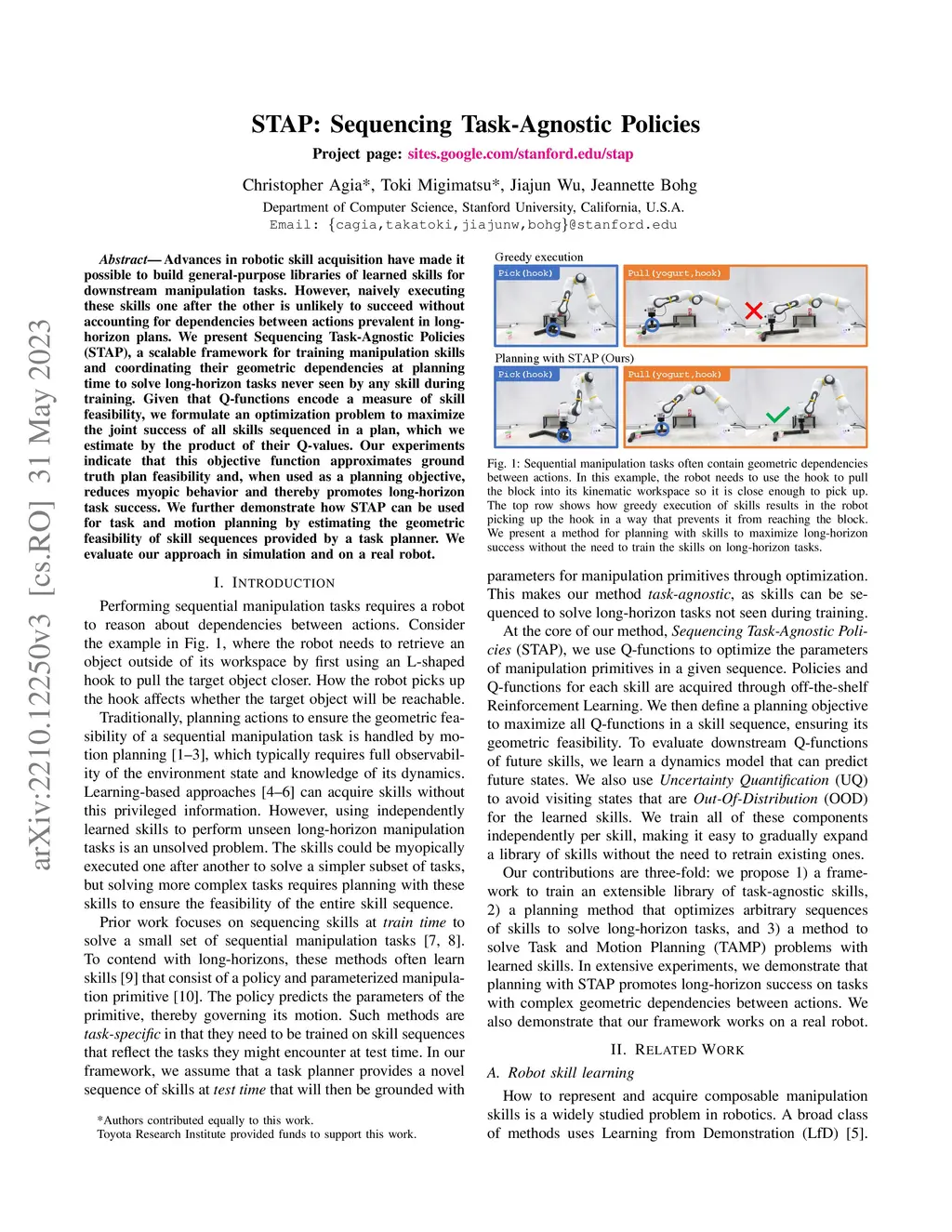
Advances in robotic skill acquisition have made it possible to build general-purpose libraries of primitive skills for downstream manipulation tasks. However, naively executing these learned primitives one after the other is unlikely to succeed without accounting for dependencies between actions prevalent in long-horizon plans. We present Task-Agnostic Policy Sequencing (TAPS), a scalable framework for training manipulation primitives and coordinating their geometric dependencies at plan-time to efficiently solve long-horizon tasks never seen by any primitive during training. Based on the notion that Q-functions encode a measure of action feasibility, we formulate motion planning as a maximization problem over the expected success of each individual primitive in the plan, which we estimate by the product of their Q-values. Our experiments indicate that this objective function approximates ground truth plan feasibility and, when used as a planning objective, reduces myopic behavior and thereby promotes task success. We further demonstrate how TAPS can be used for task and motion planning by estimating the geometric feasibility of candidate action sequences provided by a task planner. We evaluate our approach in simulation and on a real robot.
View on arXiv