
Learning Motion-Robust Remote Photoplethysmography through Arbitrary
Resolution Videos
- CVBM
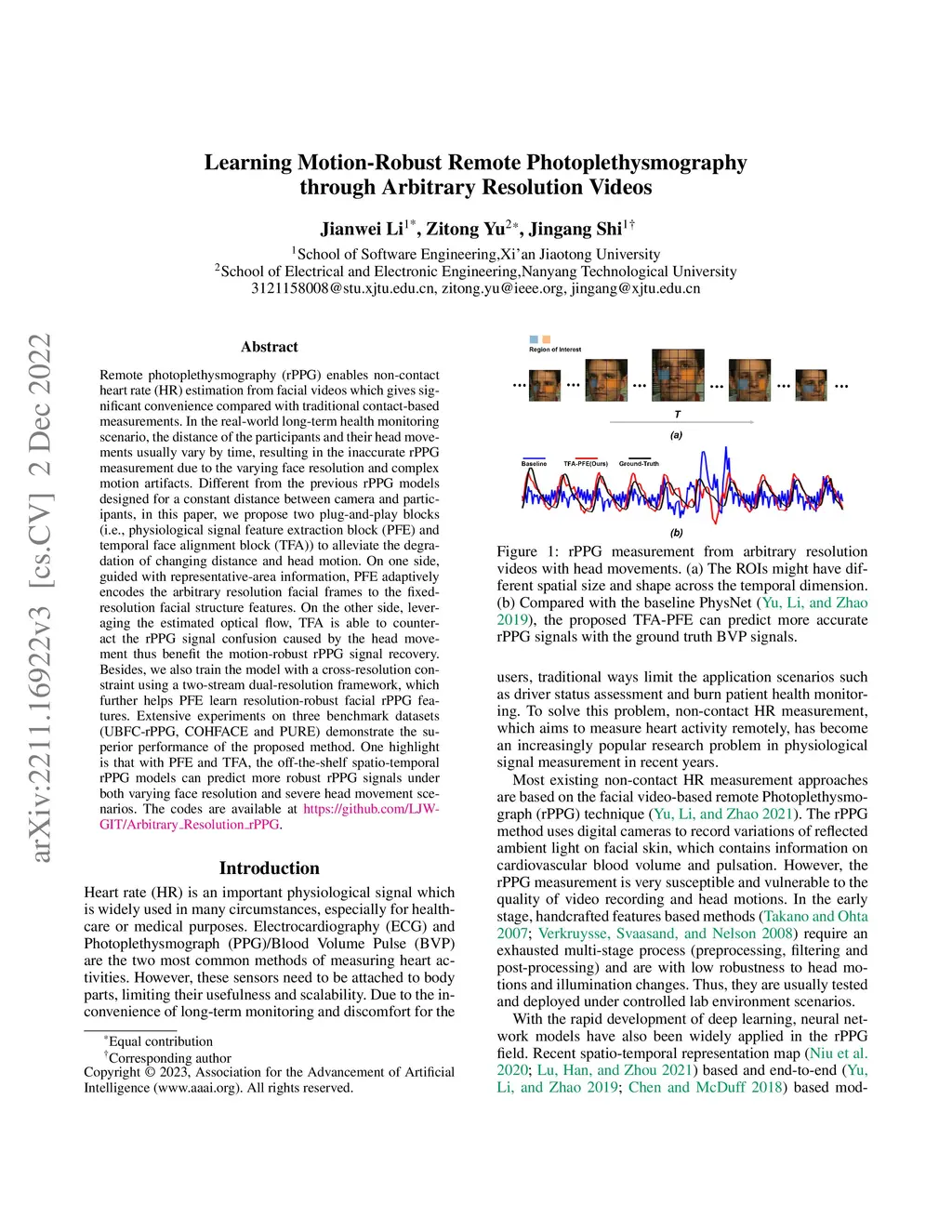
Remote photoplethysmography (rPPG) enables non-contact heart rate (HR) estimation from facial videos which gives significant convenience compared with traditional contact-based measurements. In the real-world long-term health monitoring scenario, the distance of the participants and their head movements usually vary by time, resulting in the inaccurate rPPG measurement due to the varying face resolution and complex motion artifacts. Different from the previous rPPG models designed for a constant distance between camera and participants, in this paper, we propose two plug-and-play blocks (i.e., physiological signal feature extraction block (PFE) and temporal face alignment block (TFA)) to alleviate the degradation of changing distance and head motion. On one side, guided with representative-area information, PFE adaptively encodes the arbitrary resolution facial frames to the fixed-resolution facial structure features. On the other side, leveraging the estimated optical flow, TFA is able to counteract the rPPG signal confusion caused by the head movement thus benefit the motion-robust rPPG signal recovery. Besides, we also train the model with a cross-resolution constraint using a two-stream dual-resolution framework, which further helps PFE learn resolution-robust facial rPPG features. Extensive experiments on three benchmark datasets (UBFC-rPPG, COHFACE and PURE) demonstrate the superior performance of the proposed method. One highlight is that with PFE and TFA, the off-the-shelf spatio-temporal rPPG models can predict more robust rPPG signals under both varying face resolution and severe head movement scenarios. The codes are available at https://github.com/LJW-GIT/Arbitrary_Resolution_rPPG.
View on arXiv