
Privacy-Preserving Visual Localization with Event Cameras
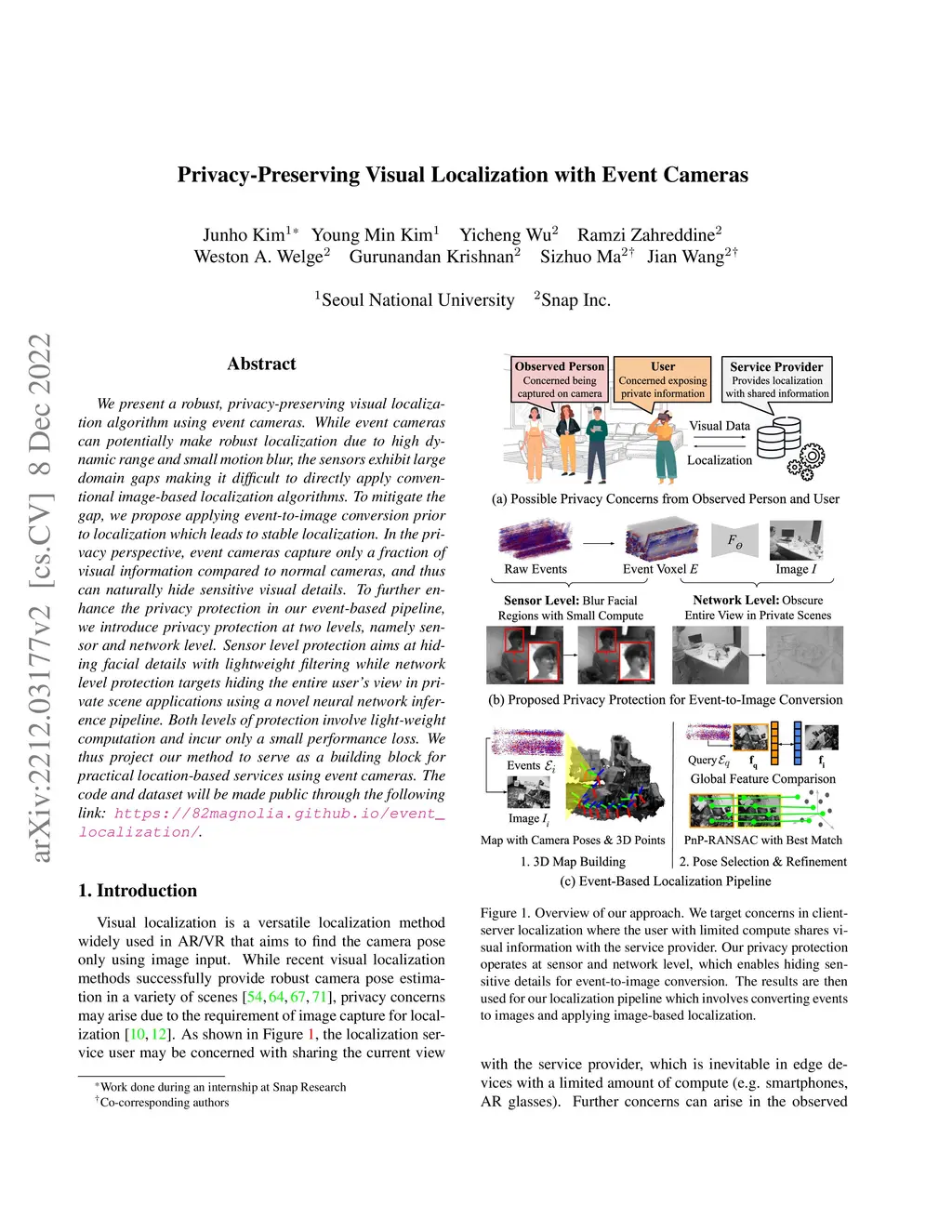
We consider the problem of client-server localization, where edge device users communicate visual data with the service provider for locating oneself against a pre-built 3D map. This localization paradigm is a crucial component for location-based services in AR/VR or mobile applications, as it is not trivial to store large-scale 3D maps and process fast localization on resource-limited edge devices. Nevertheless, conventional client-server localization systems possess numerous challenges in computational efficiency, robustness, and privacy-preservation during data transmission. Our work aims to jointly solve these challenges with a localization pipeline based on event cameras. By using event cameras, our system consumes low energy and maintains small memory bandwidth. Then during localization, we propose applying event-to-image conversion and leverage mature image-based localization, which achieves robustness even in low-light or fast-moving scenes. To further enhance privacy protection, we introduce privacy protection techniques at two levels. Network level protection aims to hide the entire user's view in private scenes using a novel split inference approach, while sensor level protection aims to hide sensitive user details such as faces with light-weight filtering. Both methods involve small client-side computation and localization performance loss, while significantly mitigating the feeling of insecurity as revealed in our user study. We thus project our method to serve as a building block for practical location-based services using event cameras. Project page including the code is available through this link:this https URL\_localization/.
View on arXiv