
STERLING: Synergistic Representation Learning on Bipartite Graphs
- SSL
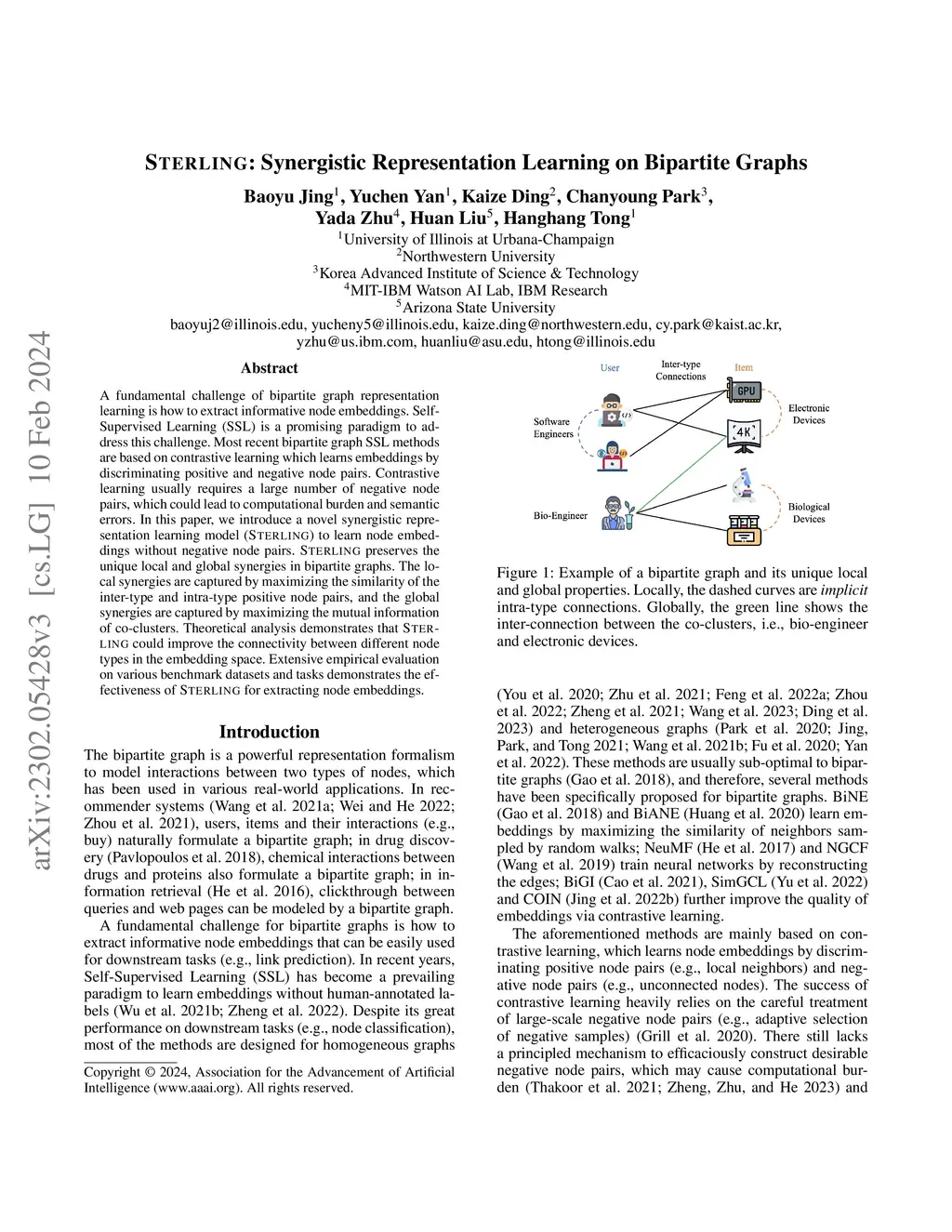
The bipartite graph is a powerful data structure for modeling interactions between two types of nodes, of which a fundamental challenge is how to extract informative node embeddings. Self-Supervised Learning (SSL) is a promising paradigm to address this challenge. Most recent bipartite graph SSL methods are based on contrastive learning which learns embeddings by discriminating positive and negative node pairs. Contrastive learning usually requires a large number of negative node pairs, which could lead to computational burden and semantic errors. In this paper, we introduce a novel synergistic representation learning model (STERLING) to learn node embeddings without negative node pairs. STERLING preserves the unique synergies in bipartite graphs. The local and global synergies are captured by maximizing the similarity of the inter-type and intra-type positive node pairs, and maximizing the mutual information of co-clusters respectively. Theoretical analysis demonstrates that STERLING could preserve the synergies in the embedding space. Extensive empirical evaluation on various benchmark datasets and tasks demonstrates the effectiveness of STERLING for extracting node embeddings.
View on arXiv