
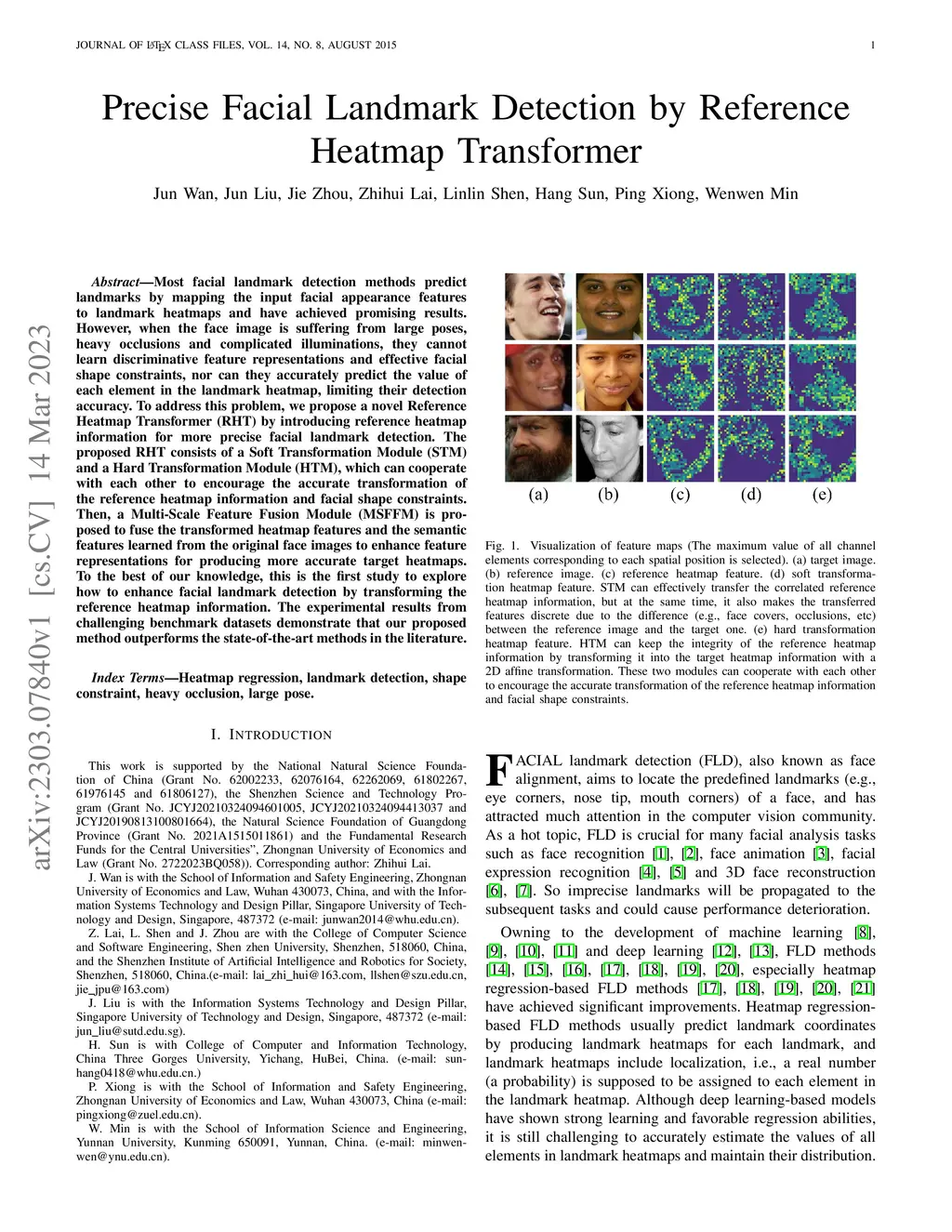
Most facial landmark detection methods predict landmarks by mapping the input facial appearance features to landmark heatmaps and have achieved promising results. However, when the face image is suffering from large poses, heavy occlusions and complicated illuminations, they cannot learn discriminative feature representations and effective facial shape constraints, nor can they accurately predict the value of each element in the landmark heatmap, limiting their detection accuracy. To address this problem, we propose a novel Reference Heatmap Transformer (RHT) by introducing reference heatmap information for more precise facial landmark detection. The proposed RHT consists of a Soft Transformation Module (STM) and a Hard Transformation Module (HTM), which can cooperate with each other to encourage the accurate transformation of the reference heatmap information and facial shape constraints. Then, a Multi-Scale Feature Fusion Module (MSFFM) is proposed to fuse the transformed heatmap features and the semantic features learned from the original face images to enhance feature representations for producing more accurate target heatmaps. To the best of our knowledge, this is the first study to explore how to enhance facial landmark detection by transforming the reference heatmap information. The experimental results from challenging benchmark datasets demonstrate that our proposed method outperforms the state-of-the-art methods in the literature.
View on arXiv