
Supervised learning with probabilistic morphisms and kernel mean
embeddings
- GAN
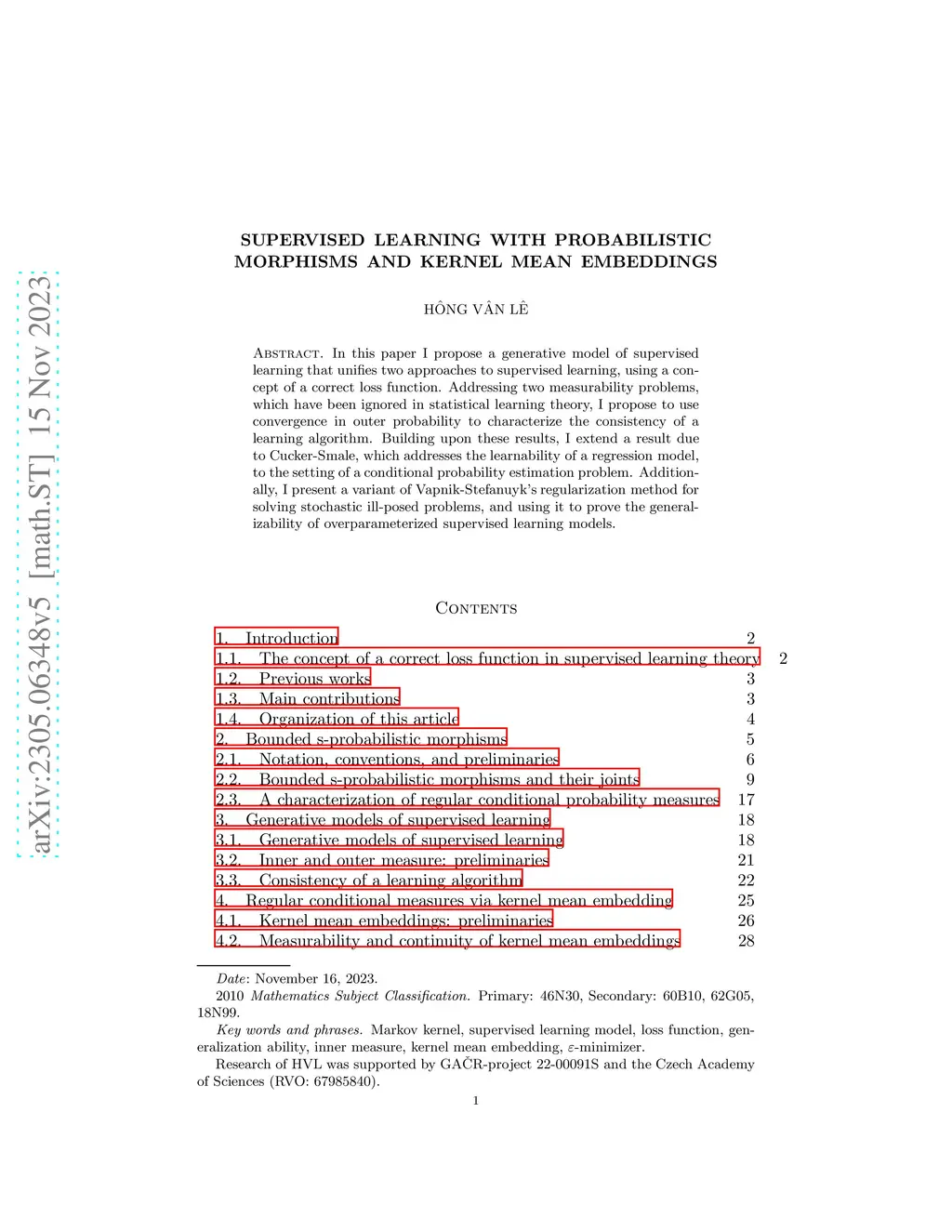
In this paper I propose a concept of a correct loss function in a generative model of supervised learning for an input space and a label space , which are measurable spaces. A correct loss function in a generative model of supervised learning must correctly measure the discrepancy between elements of a hypothesis space of possible predictors and the supervisor operator, which may not belong to . To define correct loss functions, I propose a characterization of a regular conditional probability measure for a probability measure on relative to the projection as a solution of a linear operator equation. If is a separable metrizable topological space with the Borel -algebra $ \mathcal{B} (\mathcal{Y})$, I propose another characterization of a regular conditional probability measure as a minimizer of a mean square error on the space of Markov kernels, called probabilistic morphisms, from to , using kernel mean embedding. Using these results and using inner measure to quantify generalizability of a learning algorithm, I give a generalization of a result due to Cucker-Smale, which concerns the learnability of a regression model, to a setting of a conditional probability estimation problem. I also give a variant of Vapnik's method of solving stochastic ill-posed problem, using inner measure and discuss its applications.
View on arXiv