
The Minimax Risk in Histogram-Based Uniformity Testing under Missing
Ball Alternatives
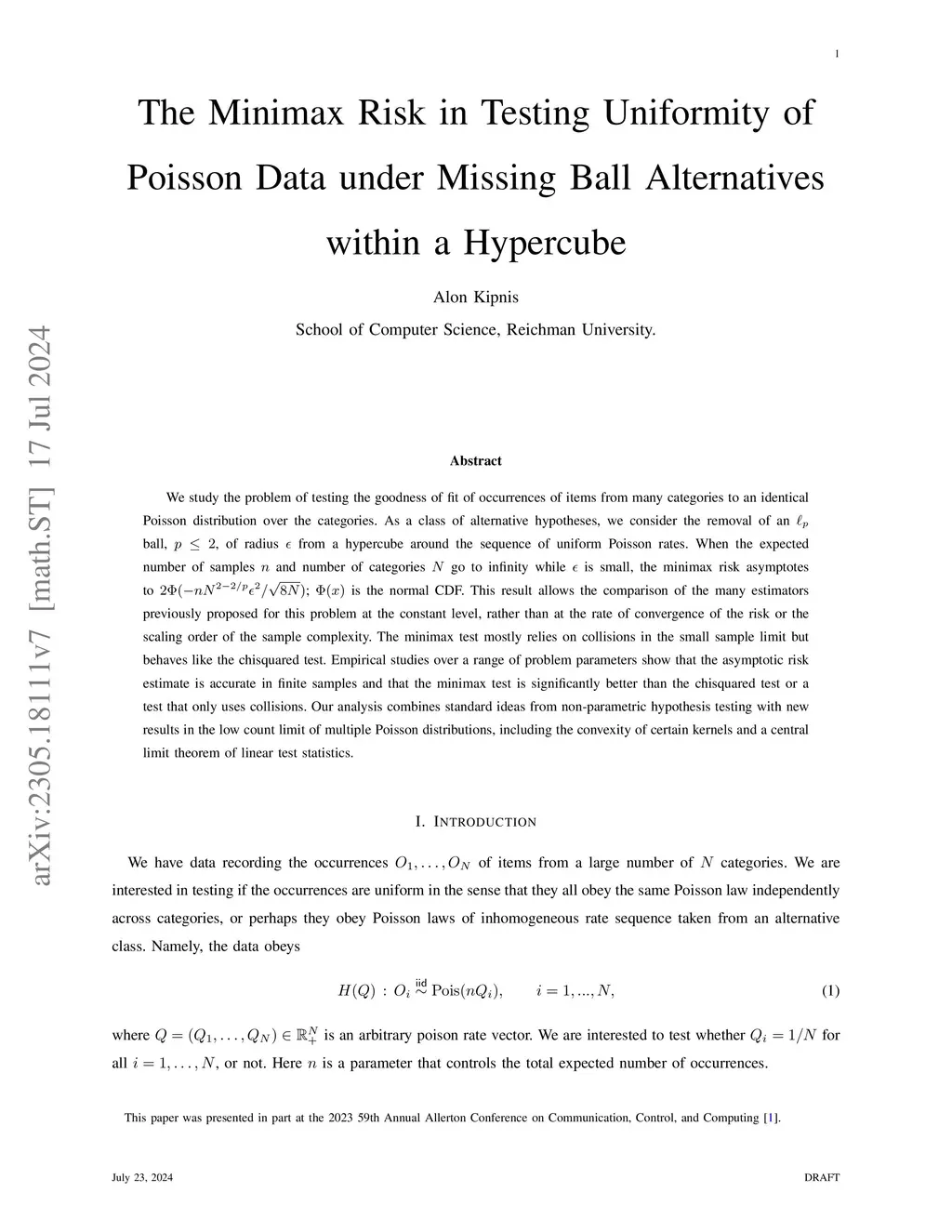
We study the problem of testing the goodness of fit of a discrete sample from many categories to the uniform distribution over the categories. As a class of alternative hypotheses, we consider the removal of an ball of radius around the uniform rate sequence for . When the number of samples and number of categories go to infinity while is small, the minimax risk in testing based on the sample's histogram (number of absent categories, singletons, collisions, ...) asymptotes to ; is the normal CDF. This result allows the comparison of the many estimators previously proposed for this problem at the constant level, rather than at the rate of convergence of the risk or the scaling order of the sample complexity. The minimax test mostly relies on collisions in the very small sample limit but otherwise behaves like the chisquared test. Empirical studies over a range of problem parameters show that our estimate is accurate in finite samples and that the minimax test is significantly better than the chisquared test or a test that only uses collisions. Our analysis relies on the asymptotic normality of histogram ordinates, the equivalence between the minimax setting and a Bayesian setting, and the characterization of the least favorable prior by reducing a multi-dimensional optimization problem to a one-dimensional problem.
View on arXiv