
Learning Models of Adversarial Agent Behavior under Partial
Observability
- AAML
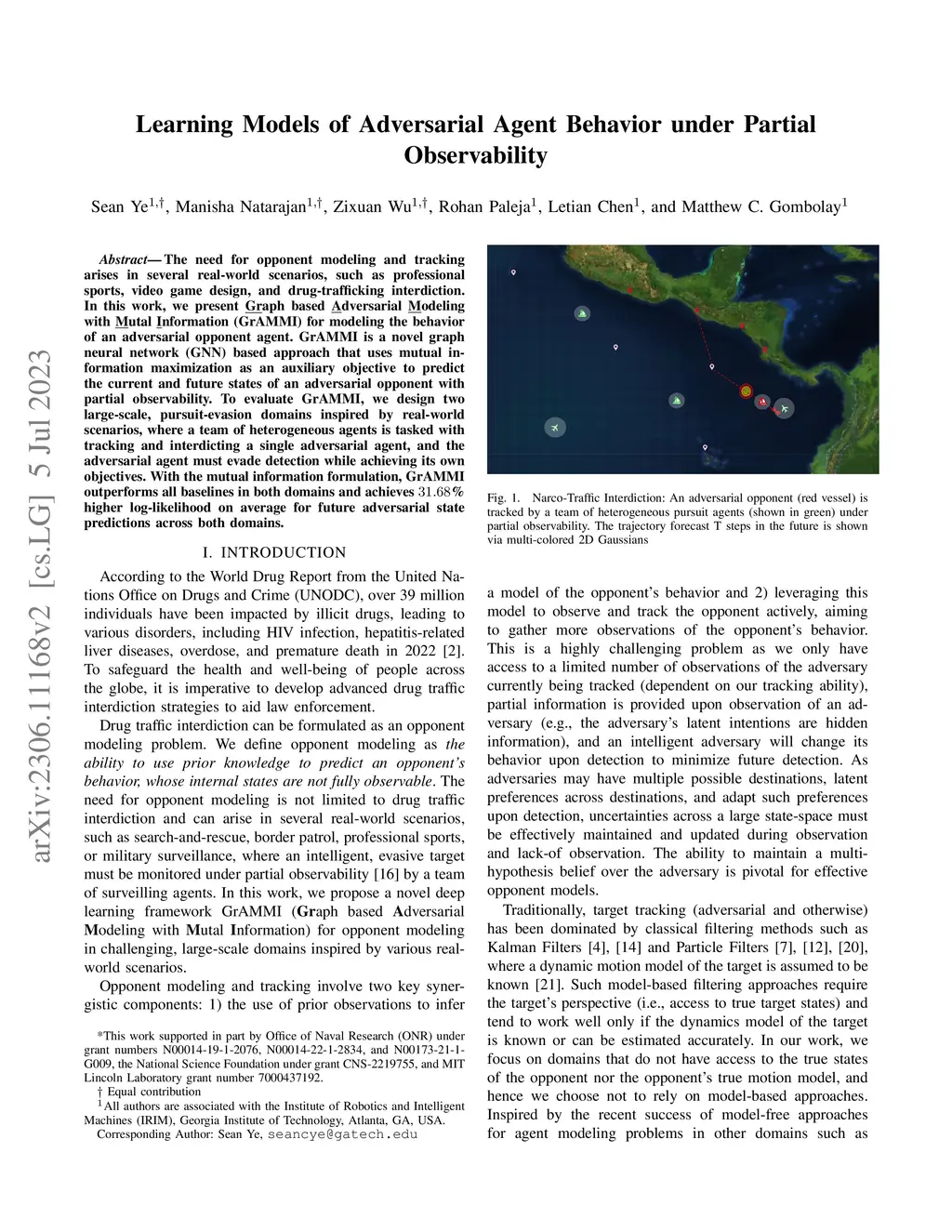
The need for opponent modeling and tracking arises in several real-world scenarios, such as professional sports, video game design, and drug-trafficking interdiction. In this work, we present graPh neurAl Network aDvErsarial MOdeliNg wIth mUtual informMation for modeling the behavior of an adversarial opponent agent. PANDEMONIUM is a novel graph neural network (GNN) based approach that uses mutual information maximization as an auxiliary objective to predict the current and future states of an adversarial opponent with partial observability. To evaluate PANDEMONIUM, we design two large-scale, pursuit-evasion domains inspired by real-world scenarios, where a team of heterogeneous agents is tasked with tracking and interdicting a single adversarial agent, and the adversarial agent must evade detection while achieving its own objectives. With the mutual information formulation, PANDEMONIUM outperforms all baselines in both domains and achieves 31.68% higher log-likelihood on average for future adversarial state predictions across both domains.
View on arXiv