
Inverse Constraint Learning and Generalization by Transferable Reward
Decomposition
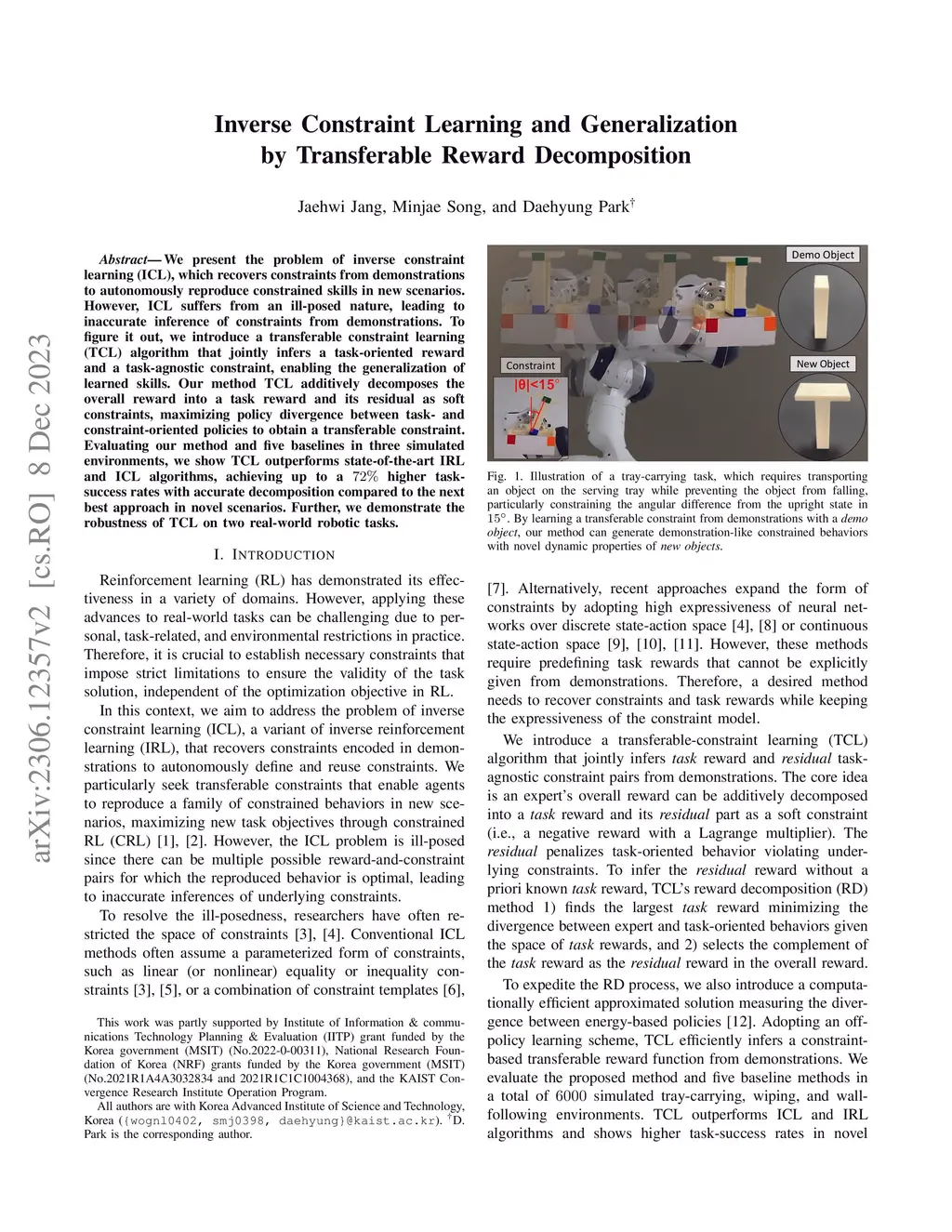
We present the problem of inverse constraint learning (ICL), which recovers constraints from demonstrations to autonomously reproduce constrained skills in new scenarios. However, ICL suffers from an ill-posed nature, leading to inaccurate inference of constraints from demonstrations. To figure it out, we introduce a transferable constraint learning (TCL) algorithm that jointly infers a task-oriented reward and a task-agnostic constraint, enabling the generalization of learned skills. Our method TCL additively decomposes the overall reward into a task reward and its residual as soft constraints, maximizing policy divergence between task- and constraint-oriented policies to obtain a transferable constraint. Evaluating our method and four baselines in three simulated environments, we show TCL outperforms state-of-the-art IRL and ICL algorithms, achieving up to a higher task-success rates with accurate decomposition compared to the next best approach in novel scenarios. Further, we demonstrate the robustness of TCL on a real-world robotic tray-carrying task.
View on arXiv