
Recognition and Estimation of Human Finger Pointing with an RGB Camera
for Robot Directive
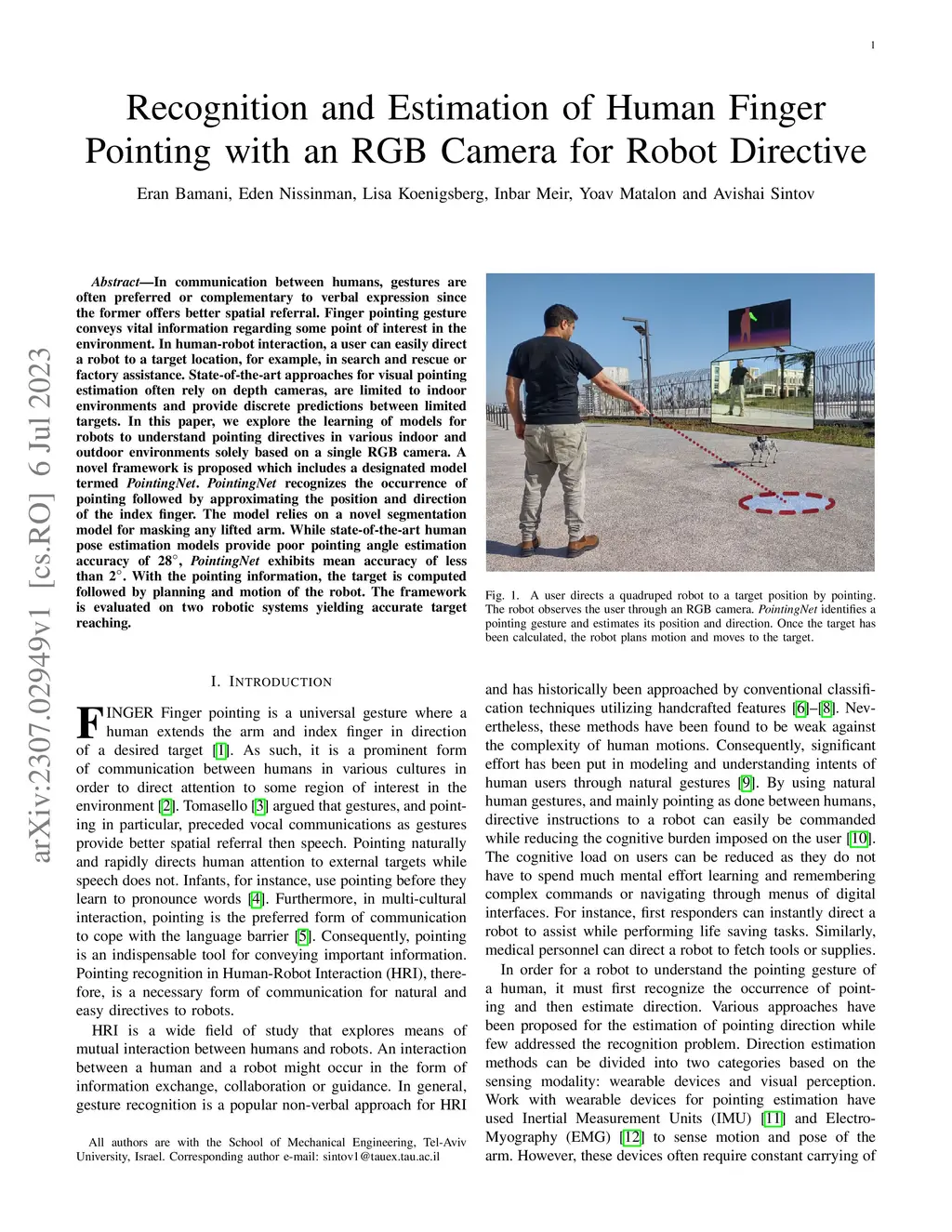
In communication between humans, gestures are often preferred or complementary to verbal expression since the former offers better spatial referral. Finger pointing gesture conveys vital information regarding some point of interest in the environment. In human-robot interaction, a user can easily direct a robot to a target location, for example, in search and rescue or factory assistance. State-of-the-art approaches for visual pointing estimation often rely on depth cameras, are limited to indoor environments and provide discrete predictions between limited targets. In this paper, we explore the learning of models for robots to understand pointing directives in various indoor and outdoor environments solely based on a single RGB camera. A novel framework is proposed which includes a designated model termed PointingNet. PointingNet recognizes the occurrence of pointing followed by approximating the position and direction of the index finger. The model relies on a novel segmentation model for masking any lifted arm. While state-of-the-art human pose estimation models provide poor pointing angle estimation accuracy of 28deg, PointingNet exhibits mean accuracy of less than 2deg. With the pointing information, the target is computed followed by planning and motion of the robot. The framework is evaluated on two robotic systems yielding accurate target reaching.
View on arXiv