
ComPtr: Towards Diverse Bi-source Dense Prediction Tasks via A Simple yet General Complementary Transformer
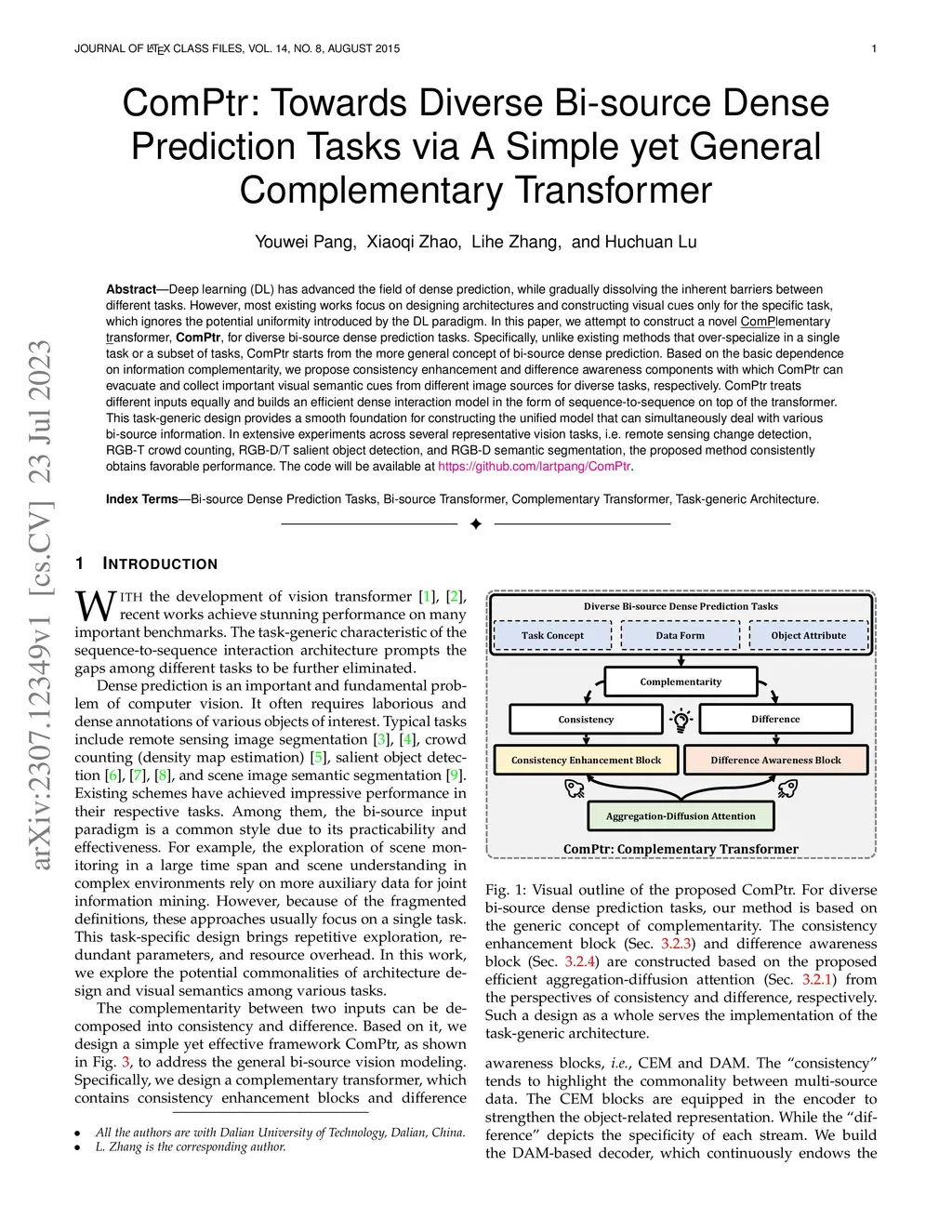
Deep learning (DL) has advanced the field of dense prediction, while gradually dissolving the inherent barriers between different tasks. However, most existing works focus on designing architectures and constructing visual cues only for the specific task, which ignores the potential uniformity introduced by the DL paradigm. In this paper, we attempt to construct a novel lementary ansformer, , for diverse bi-source dense prediction tasks. Specifically, unlike existing methods that over-specialize in a single task or a subset of tasks, ComPtr starts from the more general concept of bi-source dense prediction. Based on the basic dependence on information complementarity, we propose consistency enhancement and difference awareness components with which ComPtr can evacuate and collect important visual semantic cues from different image sources for diverse tasks, respectively. ComPtr treats different inputs equally and builds an efficient dense interaction model in the form of sequence-to-sequence on top of the transformer. This task-generic design provides a smooth foundation for constructing the unified model that can simultaneously deal with various bi-source information. In extensive experiments across several representative vision tasks, i.e. remote sensing change detection, RGB-T crowd counting, RGB-D/T salient object detection, and RGB-D semantic segmentation, the proposed method consistently obtains favorable performance. The code will be available atthis https URL.
View on arXiv