
Faster Stochastic Algorithms for Minimax Optimization under
Polyak--Łojasiewicz Conditions
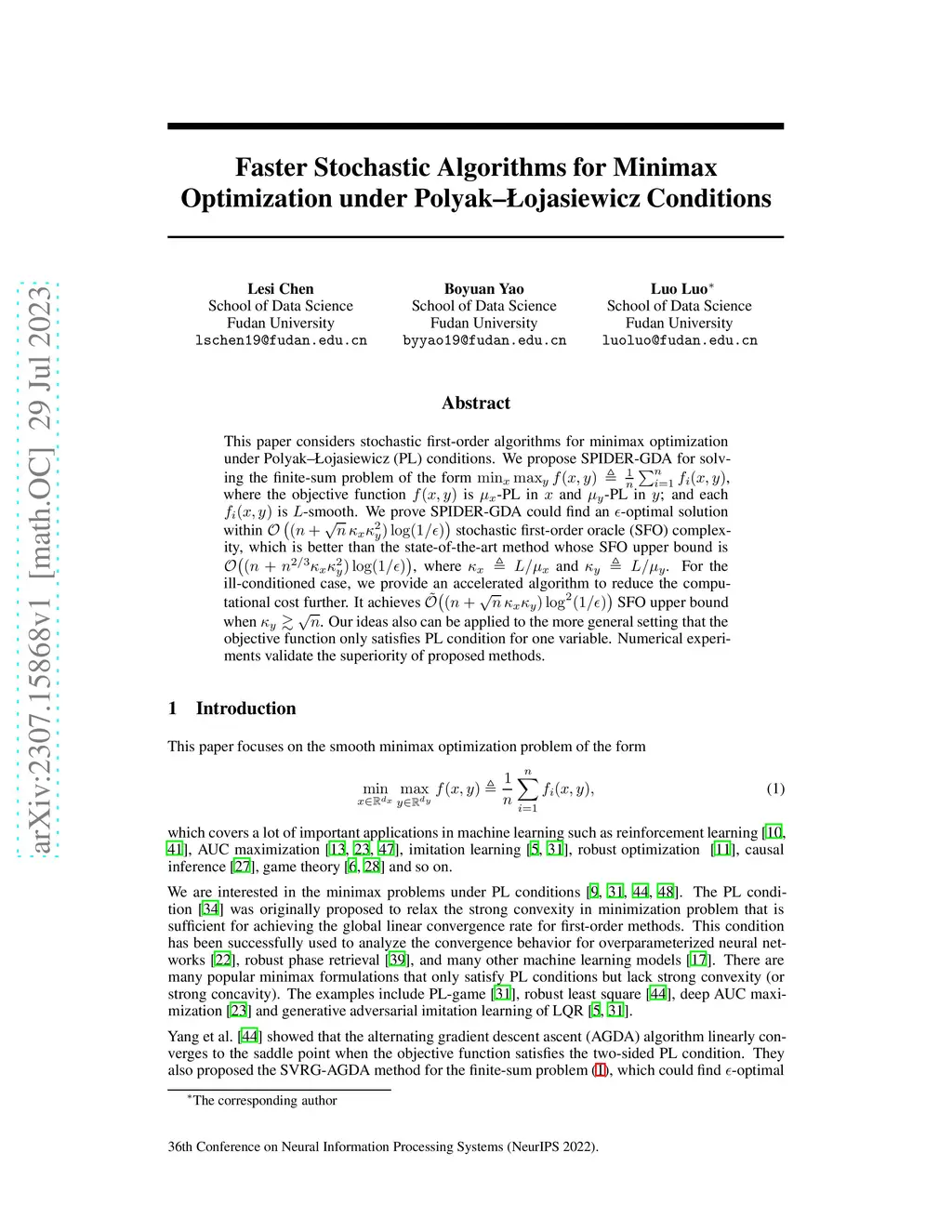
This paper considers stochastic first-order algorithms for minimax optimization under Polyak--{\L}ojasiewicz (PL) conditions. We propose SPIDER-GDA for solving the finite-sum problem of the form , where the objective function is -PL in and -PL in ; and each is -smooth. We prove SPIDER-GDA could find an -optimal solution within stochastic first-order oracle (SFO) complexity, which is better than the state-of-the-art method whose SFO upper bound is , where and . For the ill-conditioned case, we provide an accelerated algorithm to reduce the computational cost further. It achieves SFO upper bound when . Our ideas also can be applied to the more general setting that the objective function only satisfies PL condition for one variable. Numerical experiments validate the superiority of proposed methods.
View on arXiv