
MGAS: Multi-Granularity Architecture Search for Trade-Off Between Model Effectiveness and Efficiency
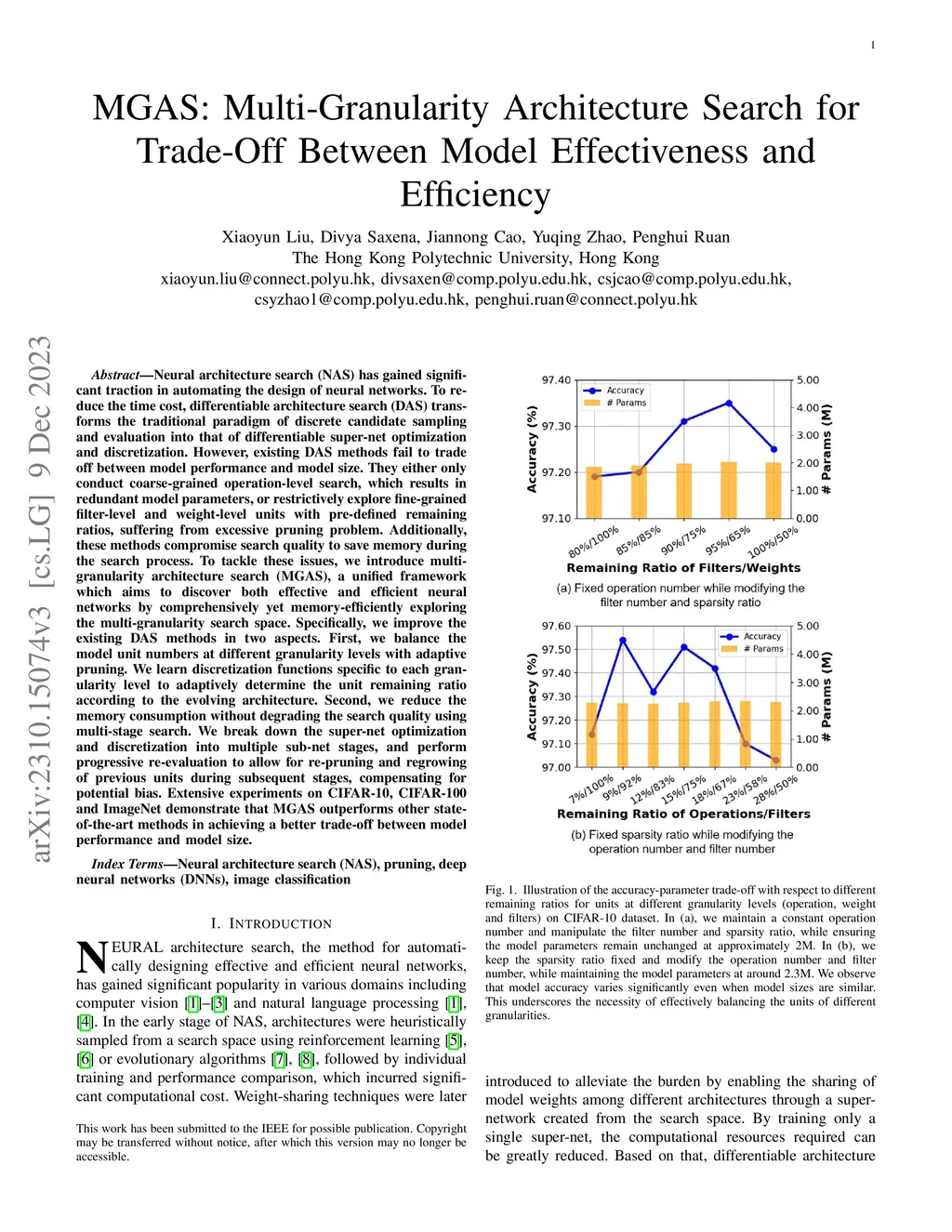
Neural architecture search (NAS) has gained significant traction in automating the design of neural networks. To reduce search time, differentiable architecture search (DAS) reframes the traditional paradigm of discrete candidate sampling and evaluation into a differentiable optimization over a super-net, followed by discretization. However, most existing DAS methods primarily focus on optimizing the coarse-grained operation-level topology, while neglecting finer-grained structures such as filter-level and weight-level patterns. This limits their ability to balance model performance with model size. Additionally, many methods compromise search quality to save memory during the search process. To tackle these issues, we propose Multi-Granularity Differentiable Architecture Search (MG-DARTS), a unified framework which aims to discover both effective and efficient architectures from scratch by comprehensively yet memory-efficiently exploring a multi-granularity search space. Specifically, we improve the existing DAS methods in two aspects. First, we adaptively adjust the retention ratios of searchable units across different granularity levels through adaptive pruning, which is achieved by learning granularity-specific discretization functions along with the evolving architecture. Second, we decompose the super-net optimization and discretization into multiple stages, each operating on a sub-net, and introduce progressive re-evaluation to enable re-pruning and regrowth of previous units, thereby mitigating potential bias. Extensive experiments on CIFAR-10, CIFAR-100 and ImageNet demonstrate that MG-DARTS outperforms other state-of-the-art methods in achieving a better trade-off between model accuracy and parameter efficiency. Codes are available atthis https URL.
View on arXiv