
Learning Realistic Joint Space Boundaries for Range of Motion Analysis of Healthy and Impaired Human Arms
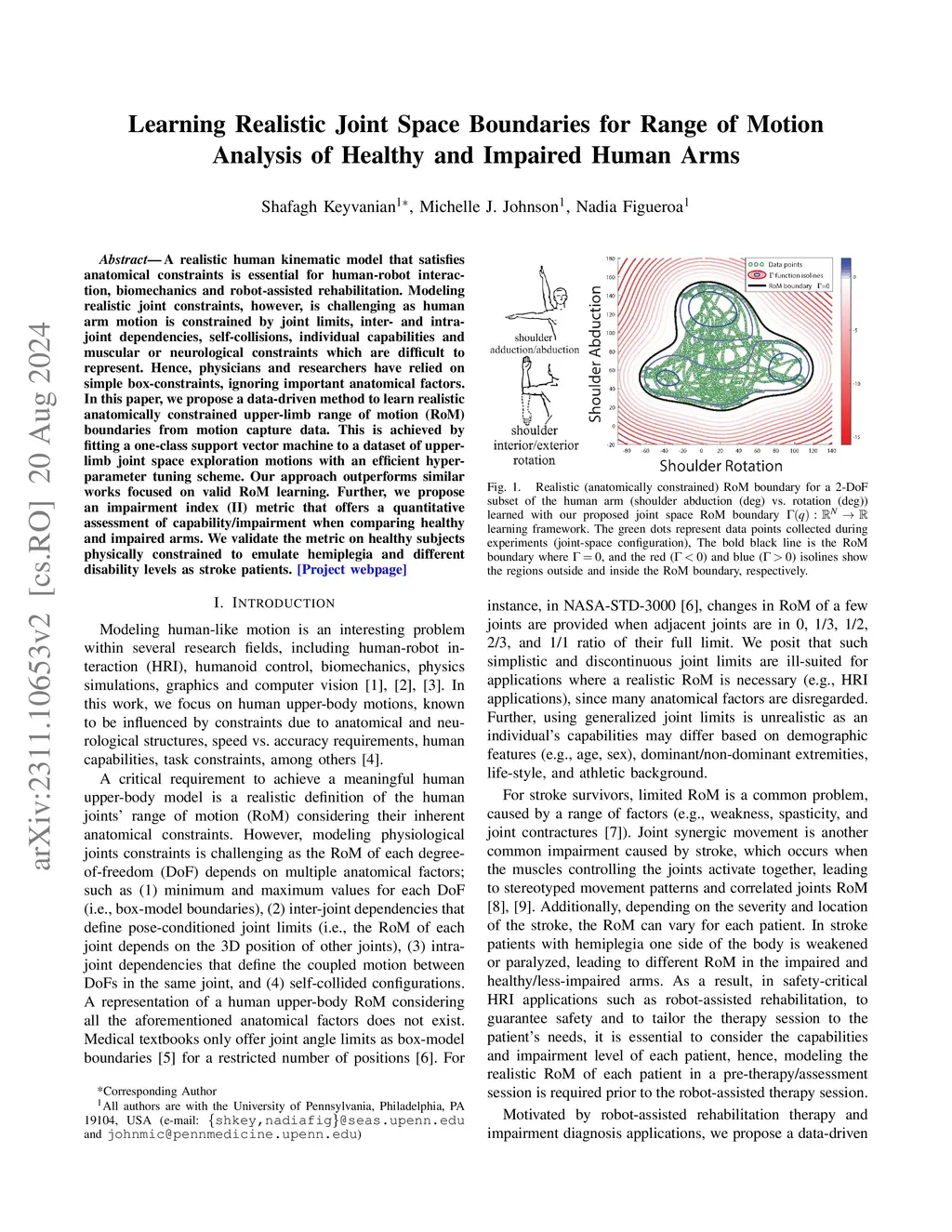
A realistic human kinematic model that satisfies anatomical constraints is essential for human-robot interaction, biomechanics and robot-assisted rehabilitation. Modeling realistic joint constraints, however, is challenging as human arm motion is constrained by joint limits, inter- and intra-joint dependencies, self-collisions, individual capabilities and muscular or neurological constraints which are difficult to represent. Hence, physicians and researchers have relied on simple box-constraints, ignoring important anatomical factors. In this paper, we propose a data-driven method to learn realistic anatomically constrained upper-limb range of motion (RoM) boundaries from motion capture data. This is achieved by fitting a one-class support vector machine to a dataset of upper-limb joint space exploration motions with an efficient hyper-parameter tuning scheme. Our approach outperforms similar works focused on valid RoM learning. Further, we propose an impairment index (II) metric that offers a quantitative assessment of capability/impairment when comparing healthy and impaired arms. We validate the metric on healthy subjects physically constrained to emulate hemiplegia and different disability levels as stroke patients.
View on arXiv