
A quasi-polynomial time algorithm for Multi-Dimensional Scaling via LP
hierarchies
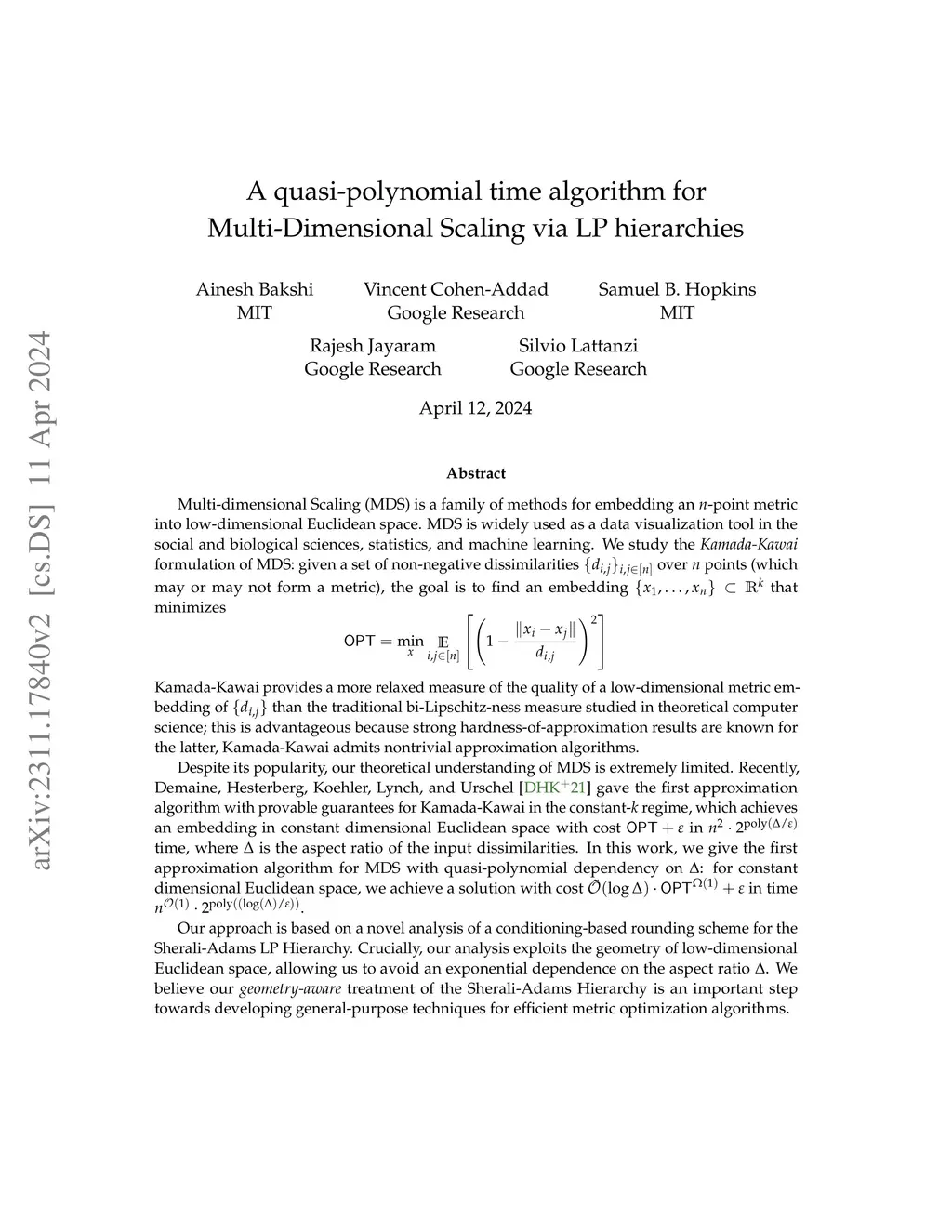
Multi-dimensional Scaling (MDS) is a family of methods for embedding pair-wise dissimilarities between objects into low-dimensional space. MDS is widely used as a data visualization tool in the social and biological sciences, statistics, and machine learning. We study the Kamada-Kawai formulation of MDS: given a set of non-negative dissimilarities over points, the goal is to find an embedding that minimizes \[ \text{OPT} = \min_{x} \mathbb{E}_{i,j \in [n]} \left[ \left(1-\frac{\|x_i - x_j\|}{d_{i,j}}\right)^2 \right] \] Despite its popularity, our theoretical understanding of MDS is extremely limited. Recently, Demaine, Hesterberg, Koehler, Lynch, and Urschel (arXiv:2109.11505) gave the first approximation algorithm with provable guarantees for Kamada-Kawai, which achieves an embedding with cost in time, where is the aspect ratio of the input dissimilarities. In this work, we give the first approximation algorithm for MDS with quasi-polynomial dependency on : for target dimension , we achieve a solution with cost in time . Our approach is based on a novel analysis of a conditioning-based rounding scheme for the Sherali-Adams LP Hierarchy. Crucially, our analysis exploits the geometry of low-dimensional Euclidean space, allowing us to avoid an exponential dependence on the aspect ratio . We believe our geometry-aware treatment of the Sherali-Adams Hierarchy is an important step towards developing general-purpose techniques for efficient metric optimization algorithms.
View on arXiv