
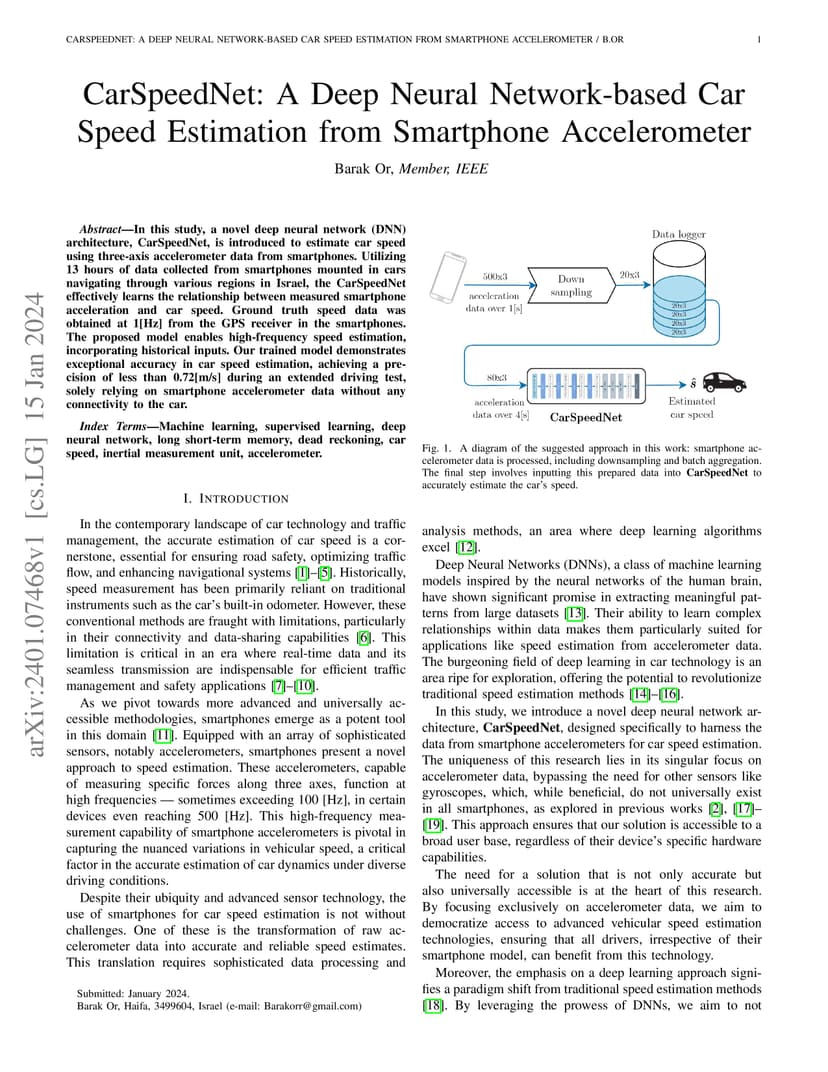
In this study, a novel deep neural network (DNN) architecture, CarSpeedNet, is introduced to estimate car speed using three-axis accelerometer data from smartphones. Utilizing 13 hours of data collected from smartphones mounted in vehicles navigating through various regions in Israel, the CarSpeedNet effectively learns the relationship between measured smartphone acceleration and car speed. Ground truth speed data was obtained at 1[Hz] from the GPS receiver in the smartphones. The proposed model enables high-frequency speed estimation, incorporating historical inputs. Our trained model demonstrates exceptional accuracy in car speed estimation, achieving a precision of less than 0.72[m/s] during an extended driving test, solely relying on smartphone accelerometer data without any connectivity to the car.
View on arXiv