
WetSpongeCake: a Surface Appearance Model Considering Porosity and
Saturation
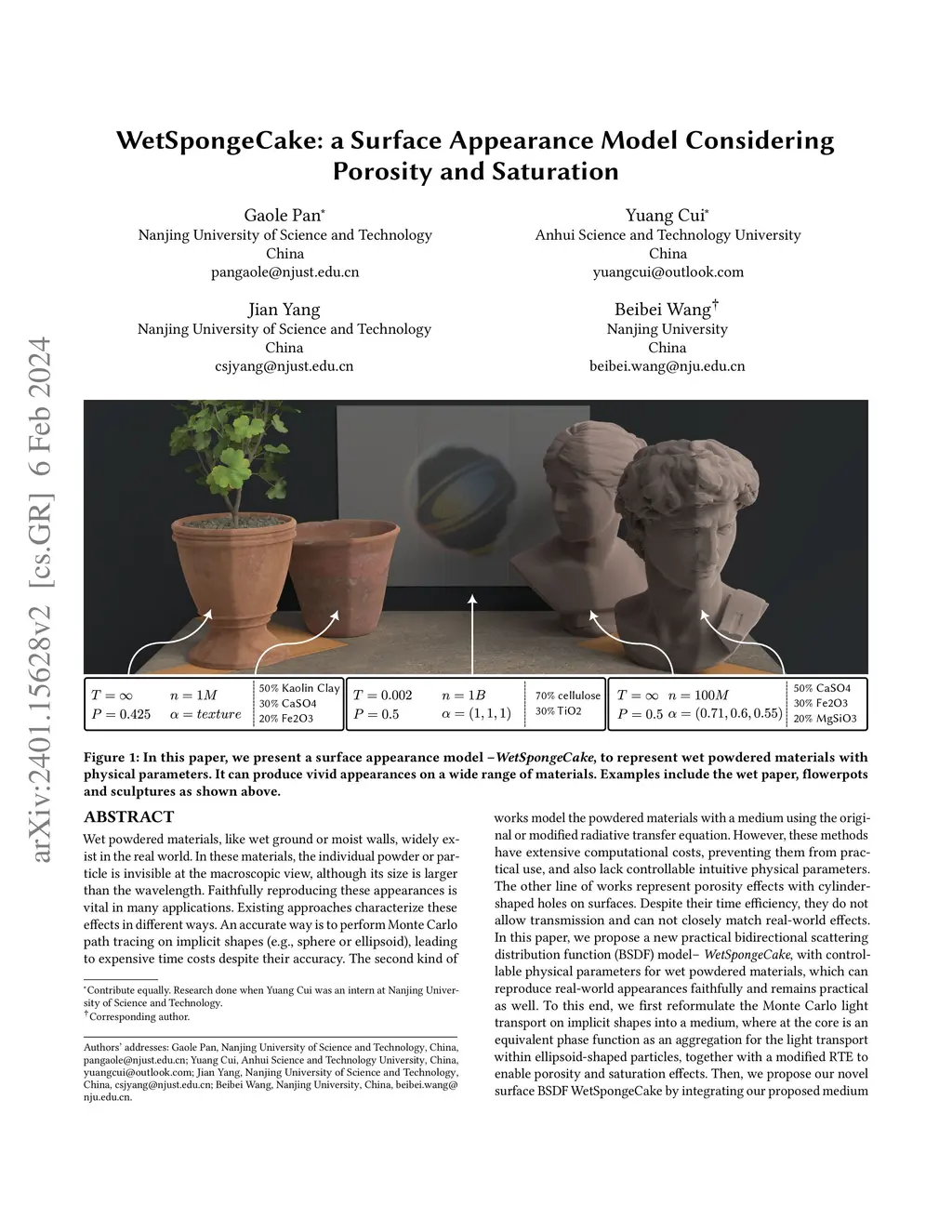
Wet powdered materials, such as wet ground or moist walls, are common in the real world. Despite their particle size being larger than the wavelength, they remain invisible from a macro view. Reproducing these appearances accurately is crucial for various applications. Existing methods use different approaches, such as Monte Carlo path tracing on implicit shapes, which is accurate but computationally expensive. Another approach involves modeling powdered materials with a medium using the radiative transfer equation, but these methods are computationally intensive and lack intuitive parameters. Some works represent porosity with cylinder-shaped holes on surfaces, but they have limitations. In this paper, we propose a practical BSDF model called WetSpongeCake for wet powdered materials. This model includes controllable physical parameters to faithfully reproduce real-world appearances while remaining computationally efficient. We reformulate Monte Carlo light transport on implicit shapes into a medium, utilizing an equivalent phase function for light transport within ellipsoid-shaped particles and a modified RTE for porosity and saturation effects. Our novel WetSpongeCake BSDF integrates this medium into the SpongeCake framework, allowing representation of various wet powdered material appearances, including both reflection and transmission. We showcase our model with examples, such as wet paper, sand saturated with different liquids, and sculptures made of multiple particles.
View on arXiv