
Seeing Through Uncertainty: A Free-Energy Approach for Real-Time Perceptual Adaptation in Robust Visual Navigation
- ViT
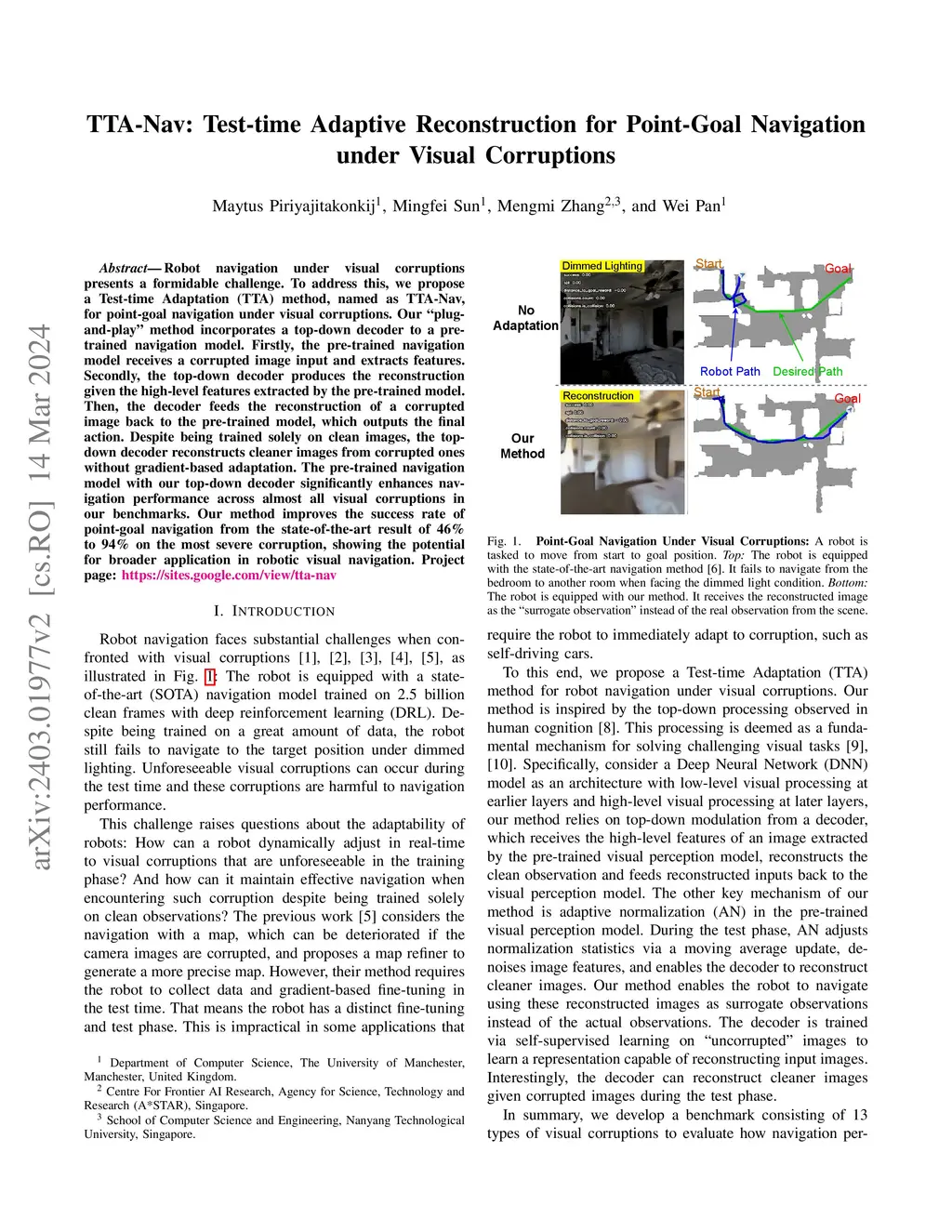
Navigation in the natural world is a feat of adaptive inference, where biological organisms maintain goal-directed behaviour despite noisy and incomplete sensory streams. Central to this ability is the Free Energy Principle (FEP), which posits that perception is a generative process where the brain minimises Variational Free Energy (VFE) to maintain accurate internal models of the world. While Deep Neural Networks (DNNs) have served as powerful analogues for biological brains, they typically lack the real-time plasticity required to handle abrupt sensory shifts. We introduce FEP-Nav, a biologically-inspired framework that implements real-time perceptual adaptation for robust visual navigation. By decomposing VFE into its constituent components--prediction error and Bayesian surprise--we propose a dual-mechanism architecture: a Top-down Decoder that provides an internal expectation of uncorrupted sensory input, and Adaptive Normalisation that dynamically aligns shifted feature distributions with prior beliefs. Theoretically, we demonstrate that this integration of reconstruction and normalisation provides a formal mechanism for minimising VFE during inference without the need for gradient-based updates. Evaluations across a diverse suite of simulated and real-world visual corruptions demonstrate that FEP-Nav facilitates a substantial recovery of navigation performance, consistently exceeding the capabilities of both non-adaptive baselines and strong adaptive methods. We show that bridging machine learning with the brain's variational principles offers a robust strategy for autonomous behaviour, enabling robots to remain functional under sensory conditions that typically degrade the performance of standard adaptive models.
View on arXiv