
Scalable Outdoors Autonomous Drone Flight with Visual-Inertial SLAM and Dense Submaps Built without LiDAR
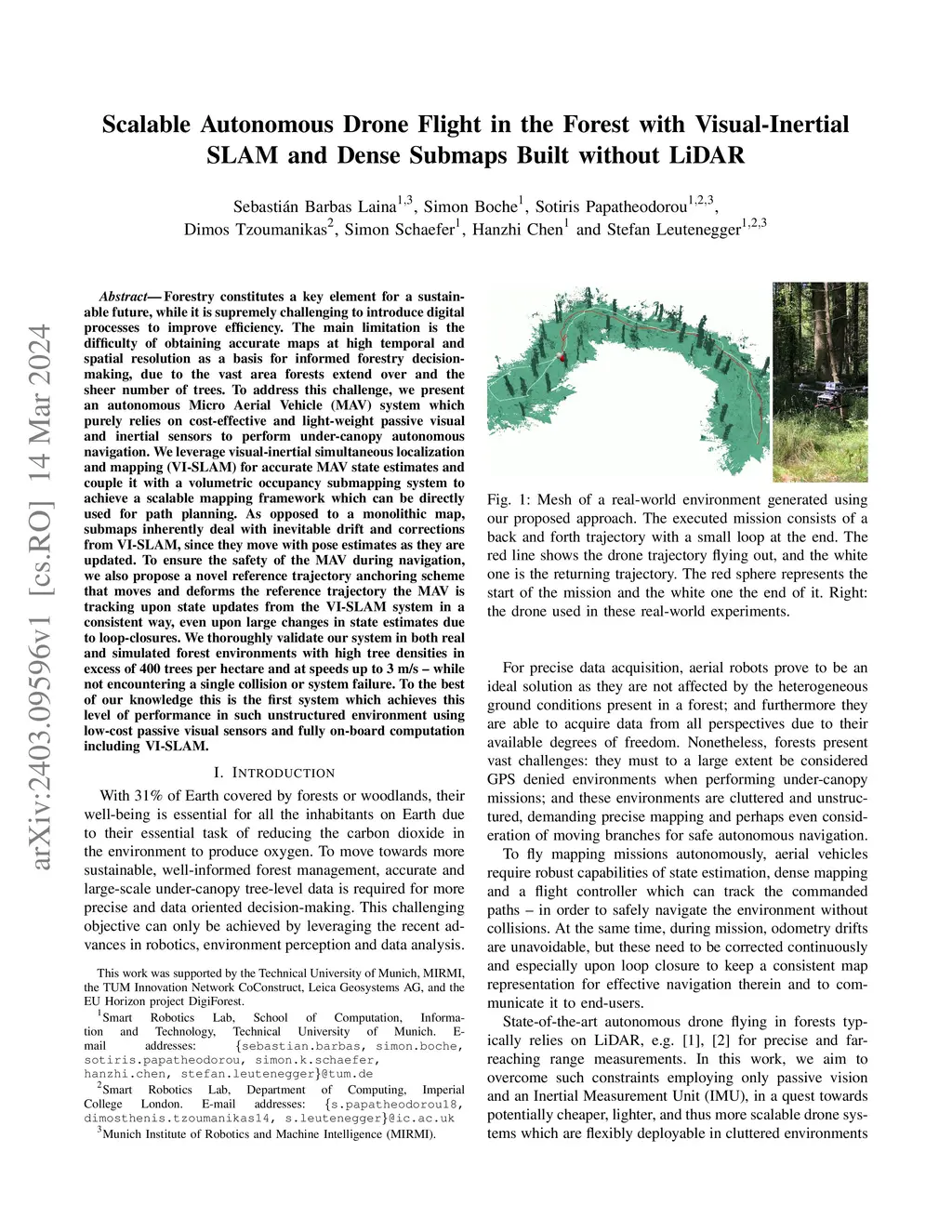
Autonomous navigation is needed for several robotics applications. In this paper we present an autonomous Micro Aerial Vehicle (MAV) system which purely relies on cost-effective and light-weight passive visual and inertial sensors to perform large-scale autonomous navigation in outdoor,unstructured and cluttered environments. We leverage visual-inertial simultaneous localization and mapping (VI-SLAM) for accurate MAV state estimates and couple it with a volumetric occupancy submapping system to achieve a scalable mapping framework which can be directly used for path planning. To ensure the safety of the MAV during navigation, we also propose a novel reference trajectory anchoring scheme that deforms the reference trajectory the MAV is tracking upon state updates from the VI-SLAM system in a consistent way, even upon large state updates due to loop-closures. We thoroughly validate our system in both real and simulated forest environments and at peak velocities up to 3 m/s while not encountering a single collision or system failure. To the best of our knowledge, this is the first system which achieves this level of performance in such an unstructured environment using low-cost passive visual sensors and fully on-board computation, including VI-SLAM.
View on arXiv