
Trusted Multi-view Learning under Noisy Supervision
- NoLaEDL
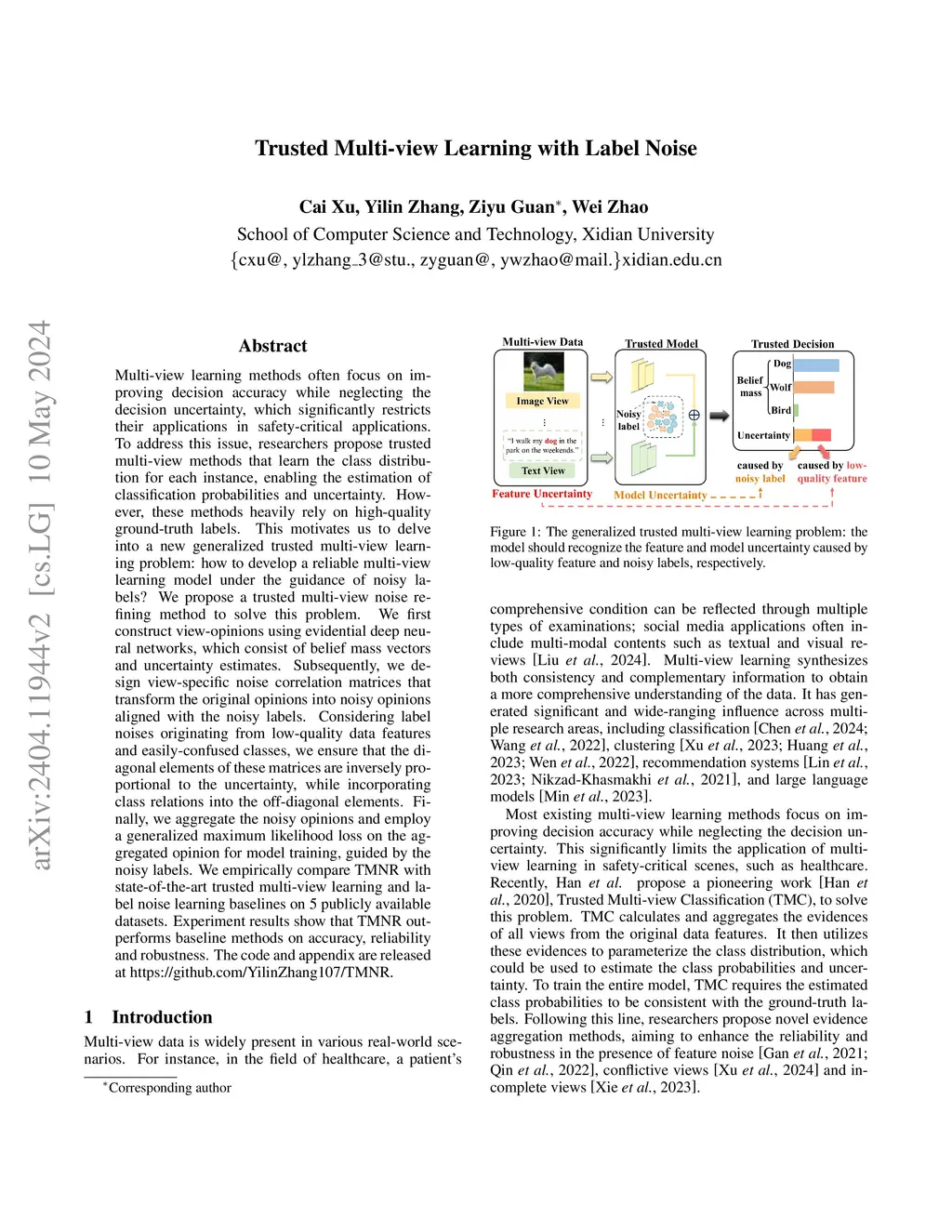
Multi-view learning methods often focus on improving decision accuracy while neglecting the decision uncertainty, which significantly restricts their applications in safety-critical scenarios. To address this, trusted multi-view learning methods estimate prediction uncertainties by learning class distributions from each instance. However, these methods heavily rely on high quality ground-truth labels. This motivates us to delve into a new problem: how to develop a reliable multi-view learning model under the guidance of noisy labels? We propose the Trusted Multi view Noise Refining (TMNR) method to address this challenge by modeling label noise arising from low-quality data features and easily-confused classes. TMNR employs evidential deep neural networks to construct view-specific opinions that capture both beliefs and uncertainty. These opinions are then transformed through noise correlation matrices to align with the noisy supervision, where matrix elements are constrained by sample uncertainty to reflect label reliability. Furthermore, considering the challenge of jointly optimizing the evidence network and noise correlation matrices under noisy supervision, we further propose Trusted Multi-view Noise Re-Refining (TMNR^2 ), which disentangles this complex co-training problem by establishing different training objectives for distinct modules. TMNR^2 identifies potentially mislabeled samples through evidence-label consistency and generates pseudo-labels from neighboring information. By assigning clean samples to optimize evidential networks and noisy samples to guide noise correlation matrices, respectively, TMNR^2 reduces mapping interference and achieves stabilizes training. Experimental results demonstrate that TMNR^2 significantly outperforms baseline methods, with average accuracy improvements of 7% on datasets with 50% label noise.
View on arXiv