
A Survey of Large Language Models on Generative Graph Analytics: Query, Learning, and Applications
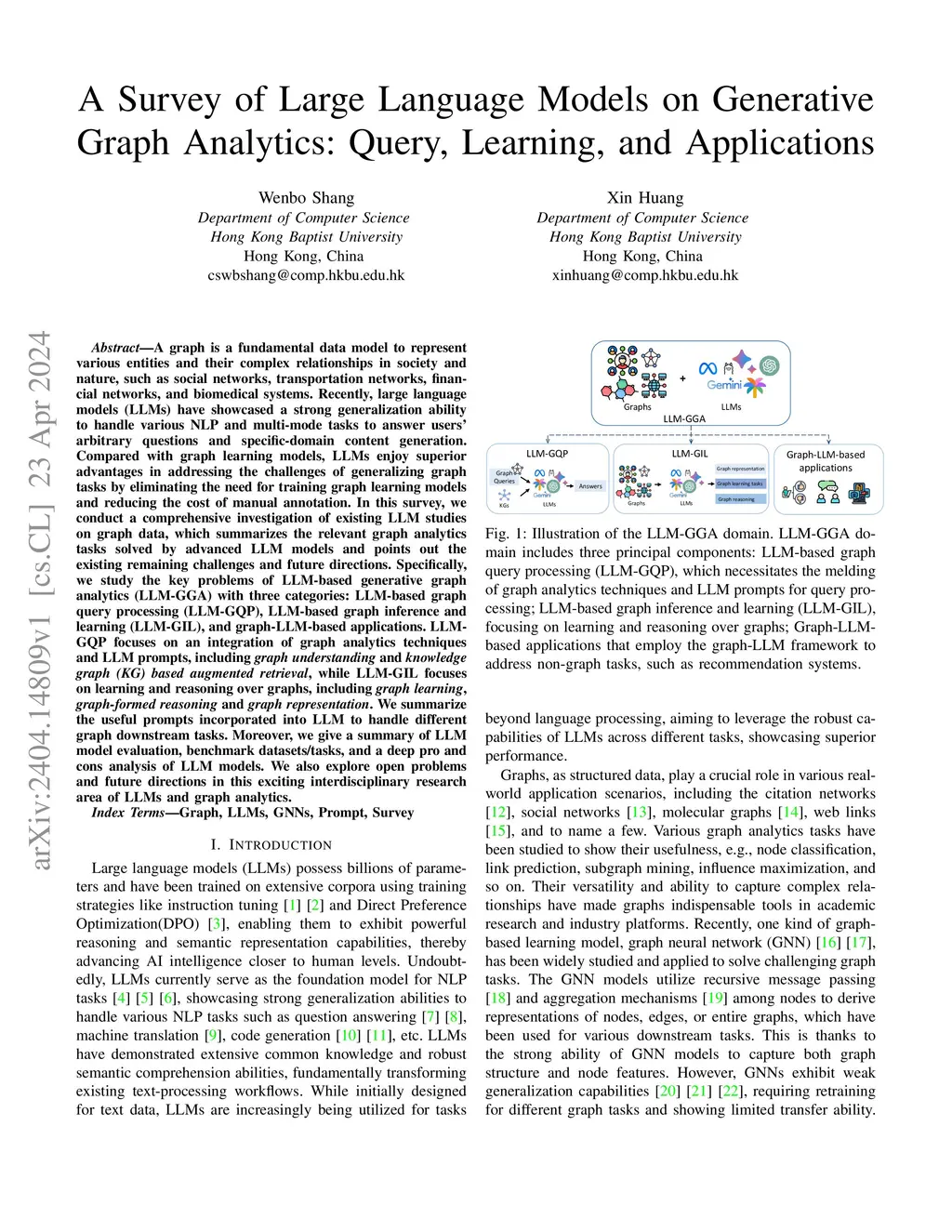
A graph is a fundamental data model to represent various entities and their complex relationships in society and nature, such as social networks, transportation networks, and financial networks. Recently, large language models (LLMs) have showcased a strong generalization ability to handle various natural language processing tasks to answer users' arbitrary questions and generate specific-domain content. Compared with graph learning models, LLMs enjoy superior advantages in addressing the challenges of generalizing graph tasks by eliminating the need for training graph learning models and reducing the cost of manual annotation. However, LLMs are sequential models for textual data, but graphs are non-sequential topological data. It is challenging to adapt LLMs to tackle graph analytics tasks. In this survey, we conduct a comprehensive investigation of existing LLM studies on graph data, which summarizes the relevant graph analytics tasks solved by advanced LLM models and points out the existing challenges and future directions. Specifically, we study the key problems of LLM-based generative graph analytics (LLM-GGA) in terms of three categories: LLM-based graph query processing (LLM-GQP), LLM-based graph inference and learning (LLM-GIL), and graph-LLM-based applications. LLM-GQP focuses on an integration of graph analytics techniques and LLM prompts, including graph understanding and knowledge graphs and LLMs, while LLM-GIL focuses on learning and reasoning over graphs, including graph learning, graph-formed reasoning, and graph representation. We summarize the useful prompts incorporated into LLM to handle different graph downstream tasks. Moreover, we give a summary of LLM model evaluation, benchmark datasets/tasks, and a deep pro and cons analysis of the discussed LLM-GGA models. We also explore open problems and future directions in the research area of LLMs and graph analytics.
View on arXiv