
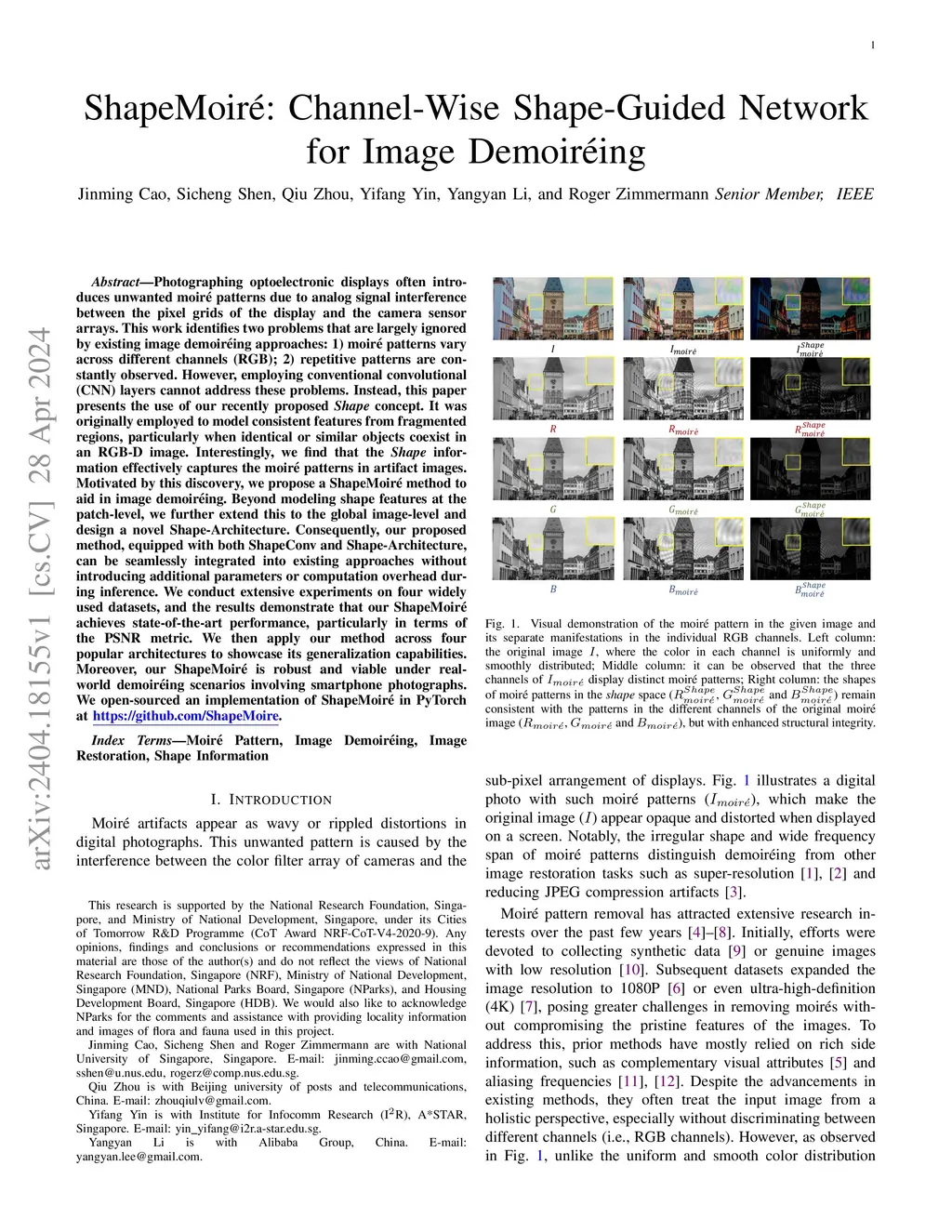
Photographing optoelectronic displays often introduces unwanted moiré patterns due to analog signal interference between the pixel grids of the display and the camera sensor arrays. This work identifies two problems that are largely ignored by existing image demoiréing approaches: 1) moiré patterns vary across different channels (RGB); 2) repetitive patterns are constantly observed. However, employing conventional convolutional (CNN) layers cannot address these problems. Instead, this paper presents the use of our recently proposed \emph{Shape} concept. It was originally employed to model consistent features from fragmented regions, particularly when identical or similar objects coexist in an RGB-D image. Interestingly, we find that the Shape information effectively captures the moiré patterns in artifact images. Motivated by this discovery, we propose a new method, ShapeMoiré, for image demoiréing. Beyond modeling shape features at the patch-level, we further extend this to the global image-level and design a novel Shape-Architecture. Consequently, our proposed method, equipped with both ShapeConv and Shape-Architecture, can be seamlessly integrated into existing approaches without introducing any additional parameters or computation overhead during inference. We conduct extensive experiments on four widely used datasets, and the results demonstrate that our ShapeMoiré achieves state-of-the-art performance, particularly in terms of the PSNR metric.
View on arXiv