
Human-Robot Interaction Conversational User Enjoyment Scale (HRI CUES)
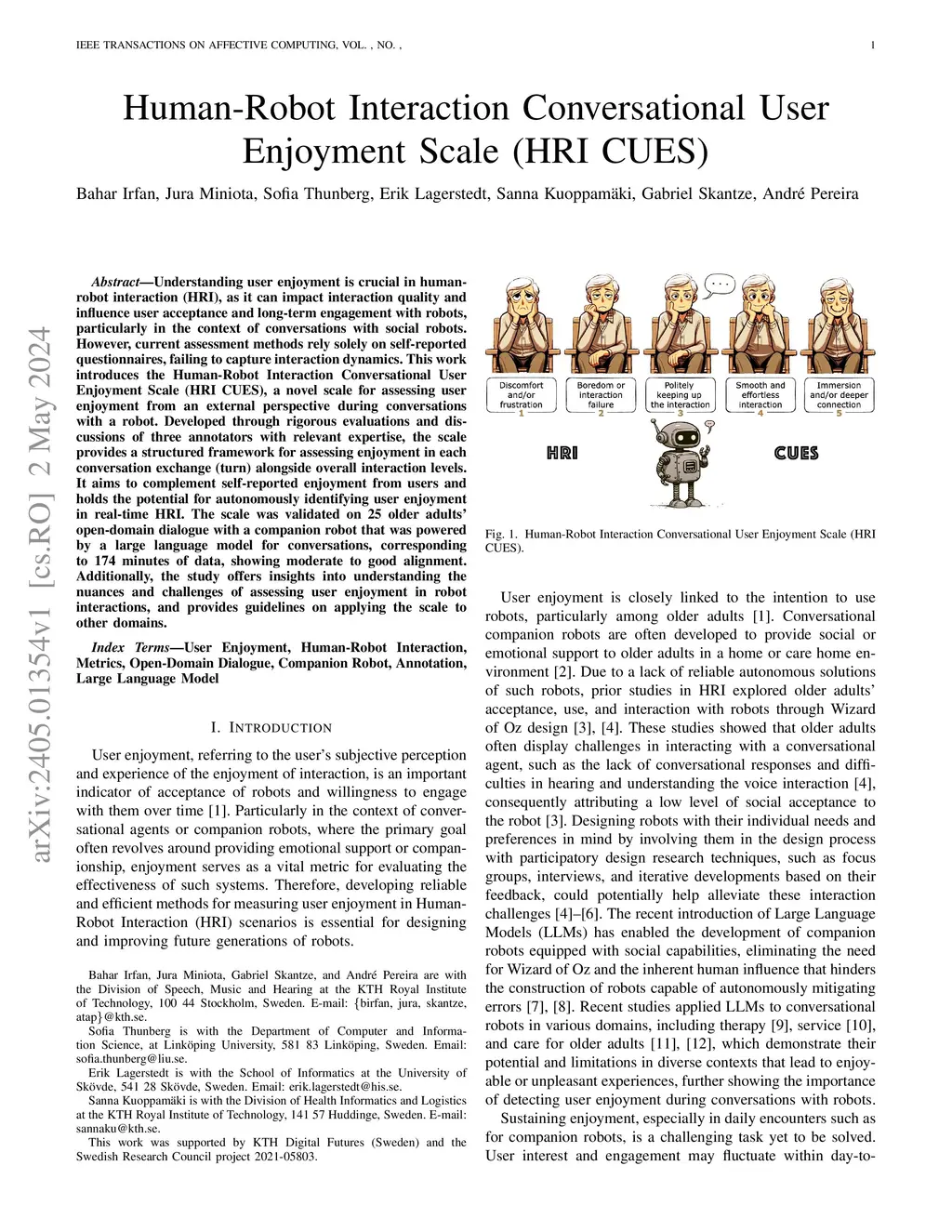
Understanding user enjoyment is crucial in human-robot interaction (HRI), as it can impact interaction quality and influence user acceptance and long-term engagement with robots, particularly in the context of conversations with social robots. However, current assessment methods rely solely on self-reported questionnaires, failing to capture interaction dynamics. This work introduces the Human-Robot Interaction Conversational User Enjoyment Scale (HRI CUES), a novel 5-point scale to assess user enjoyment from an external perspective (e.g. by an annotator) for conversations with a robot. The scale was developed through rigorous evaluations and discussions among three annotators with relevant expertise, using open-domain conversations with a companion robot that was powered by a large language model, and was applied to each conversation exchange (i.e. a robot-participant turn pair) alongside overall interaction. It was evaluated on 25 older adults' interactions with the companion robot, corresponding to 174 minutes of data, showing moderate to good alignment between annotators. Although the scale was developed and tested in the context of older adult interactions with a robot, its basis in general and non-task-specific indicators of enjoyment supports its broader applicability. The study further offers insights into understanding the nuances and challenges of assessing user enjoyment in robot interactions, and provides guidelines on applying the scale to other domains and populations. The dataset is available online.
View on arXiv