
Multi-Margin Loss: Proposal and Application in Recommender Systems
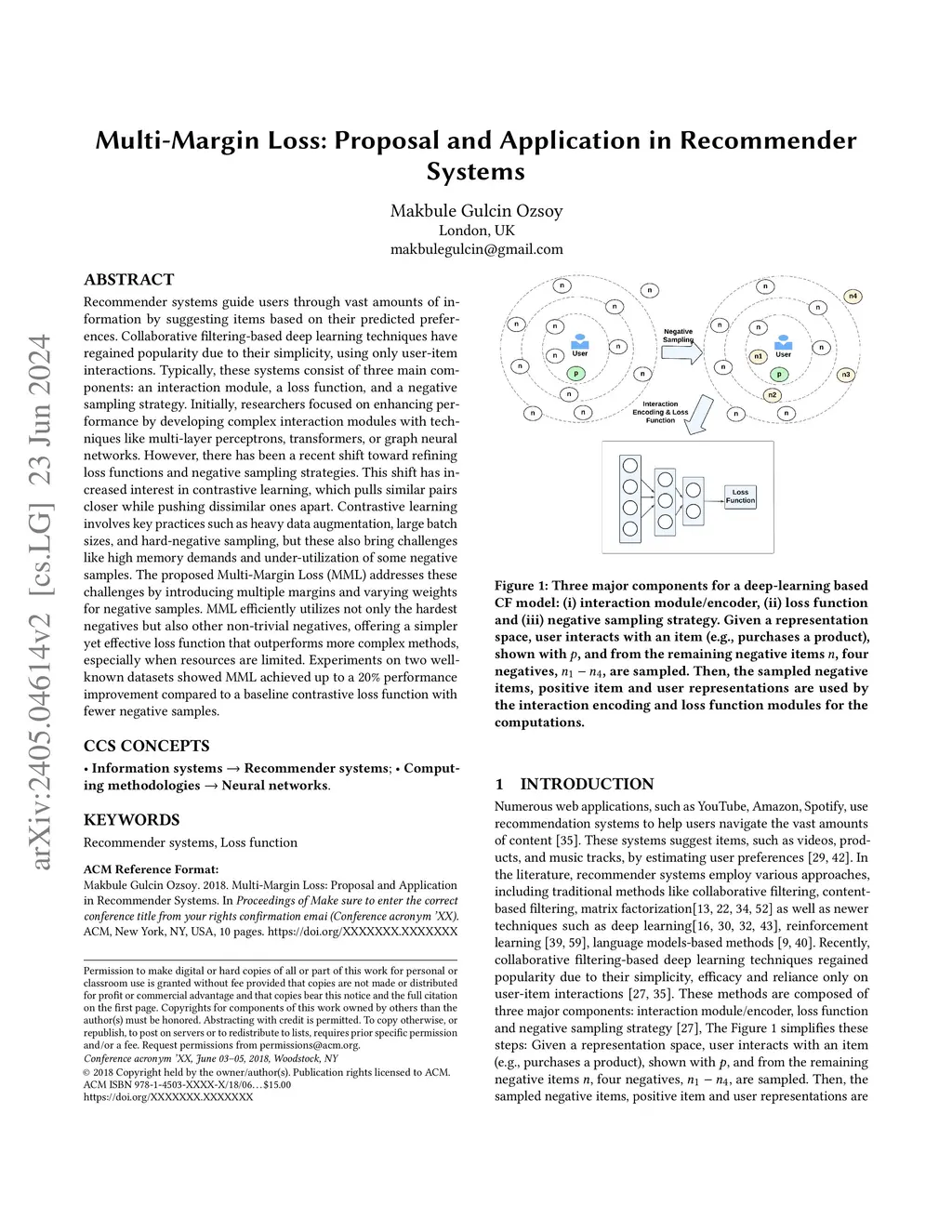
Recommender systems guide users through vast amounts of information by suggesting items based on their predicted preferences. Collaborative filtering-based deep learning techniques have regained popularity due to their simplicity, using only user-item interactions. Typically, these systems consist of three main components: an interaction module, a loss function, and a negative sampling strategy. Initially, researchers focused on enhancing performance by developing complex interaction modules with techniques like multi-layer perceptrons, transformers, or graph neural networks. However, there has been a recent shift toward refining loss functions and negative sampling strategies. This shift has increased interest in contrastive learning, which pulls similar pairs closer while pushing dissimilar ones apart. Contrastive learning involves key practices such as heavy data augmentation, large batch sizes, and hard-negative sampling, but these also bring challenges like high memory demands and under-utilization of some negative samples. The proposed Multi-Margin Loss (MML) addresses these challenges by introducing multiple margins and varying weights for negative samples. MML efficiently utilizes not only the hardest negatives but also other non-trivial negatives, offering a simpler yet effective loss function that outperforms more complex methods, especially when resources are limited. Experiments on two well-known datasets showed MML achieved up to a 20\% performance improvement compared to a baseline contrastive loss function with fewer negative samples.
View on arXiv