
Real-Time Forecasting of Pathological Gait via IMU Navigation: A Few-Shot and Generative Learning Framework for Wearable Devices
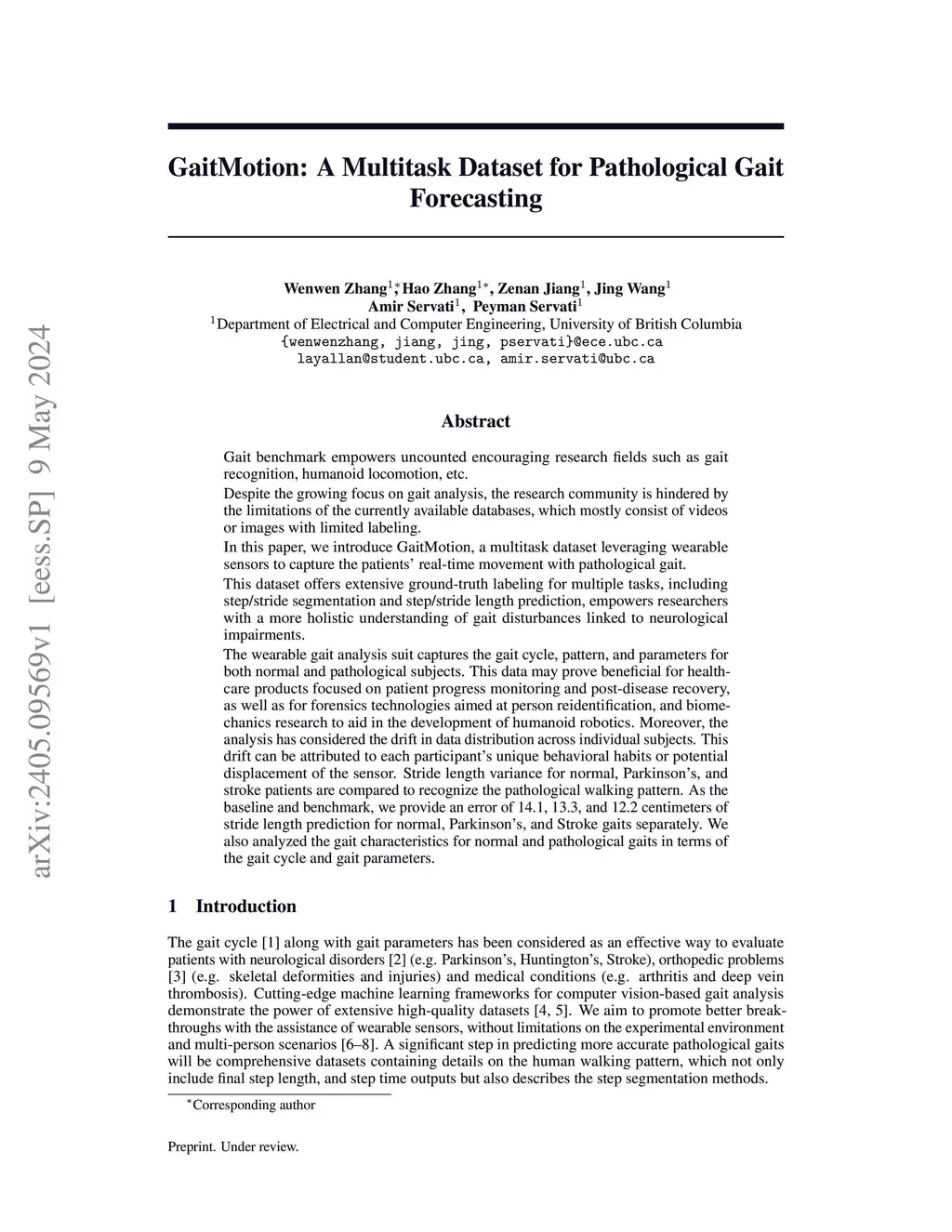
Current gait analysis faces challenges in various aspects, including limited and poorly labeled data within existing wearable electronics databases, difficulties in collecting patient data due to privacy concerns, and the inadequacy of the Zero-Velocity Update Technique (ZUPT) in accurately analyzing pathological gait patterns. To address these limitations, we introduce GaitMotion, a novel machine-learning framework that employs few-shot learning on a multitask dataset collected via wearable IMU sensors for real-time pathological gait analysis. GaitMotion enhances data quality through detailed, ground-truth-labeled sequences and achieves accurate step and stride segmentation and stride length estimation, which are essential for diagnosing neurological disorders. We incorporate a generative augmentation component, which synthesizes rare or underrepresented pathological gait patterns. GaitMotion achieves a 65\% increase in stride length estimation accuracy compared to ZUPT. In addition, its application to real patient datasets via transfer learning confirms its robust predictive capability. By integrating generative AI into wearable gait analysis, GaitMotion not only refines the precision of pathological gait forecasting but also demonstrates a scalable framework for leveraging synthetic data in biomechanical pattern recognition, paving the way for more personalized and data-efficient digital health services.
View on arXiv