
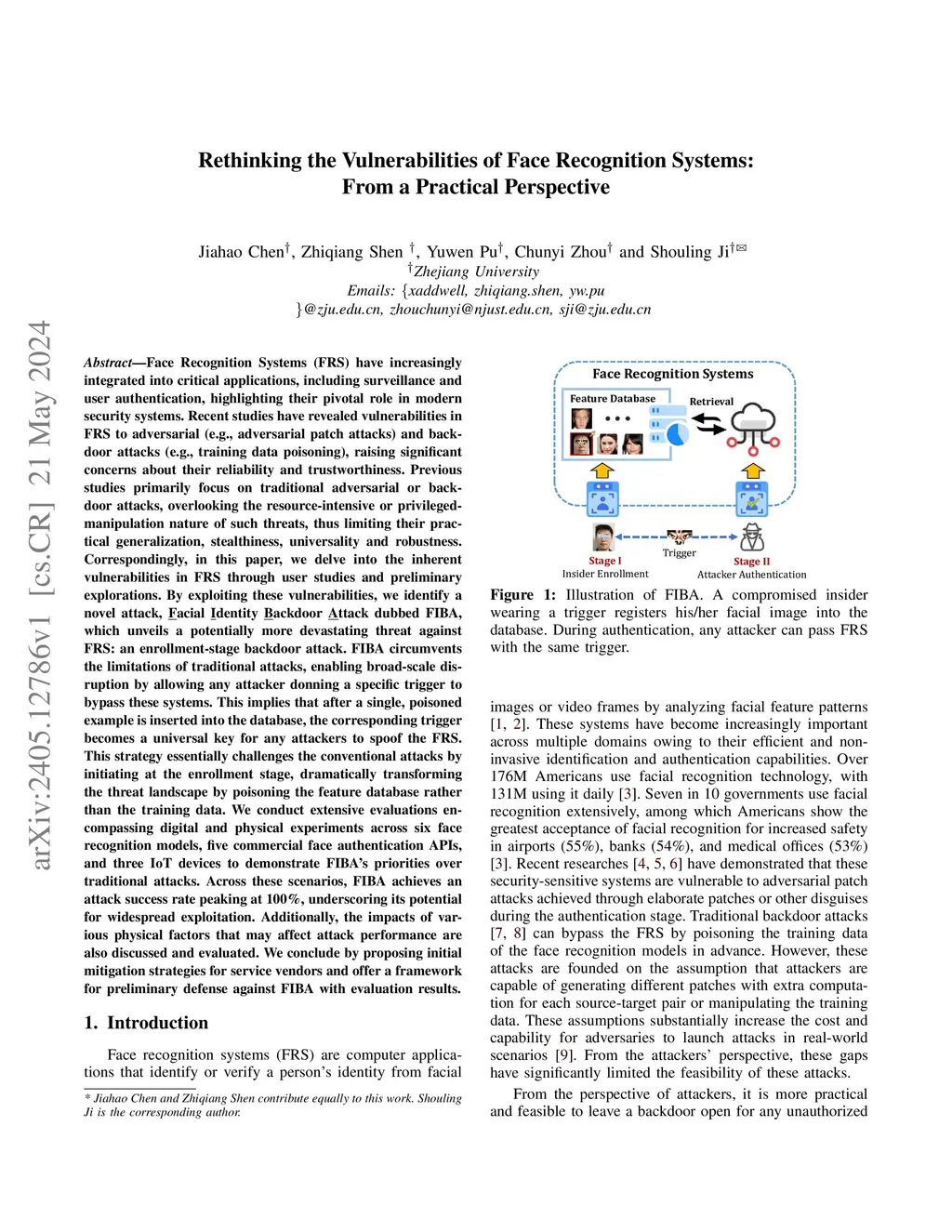
Face Recognition Systems (FRS) have increasingly integrated into critical applications, including surveillance and user authentication, highlighting their pivotal role in modern security systems. Recent studies have revealed vulnerabilities in FRS to adversarial (e.g., adversarial patch attacks) and backdoor attacks (e.g., training data poisoning), raising significant concerns about their reliability and trustworthiness. Previous studies primarily focus on traditional adversarial or backdoor attacks, overlooking the resource-intensive or privileged-manipulation nature of such threats, thus limiting their practical generalization, stealthiness, universality and robustness. Correspondingly, in this paper, we delve into the inherent vulnerabilities in FRS through user studies and preliminary explorations. By exploiting these vulnerabilities, we identify a novel attack, facial identity backdoor attack dubbed FIBA, which unveils a potentially more devastating threat against FRS:an enrollment-stage backdoor attack. FIBA circumvents the limitations of traditional attacks, enabling broad-scale disruption by allowing any attacker donning a specific trigger to bypass these systems. This implies that after a single, poisoned example is inserted into the database, the corresponding trigger becomes a universal key for any attackers to spoof the FRS. This strategy essentially challenges the conventional attacks by initiating at the enrollment stage, dramatically transforming the threat landscape by poisoning the feature database rather than the training data.
View on arXiv