
On the Robustness of Language Models for Tabular Question Answering
- LMTD
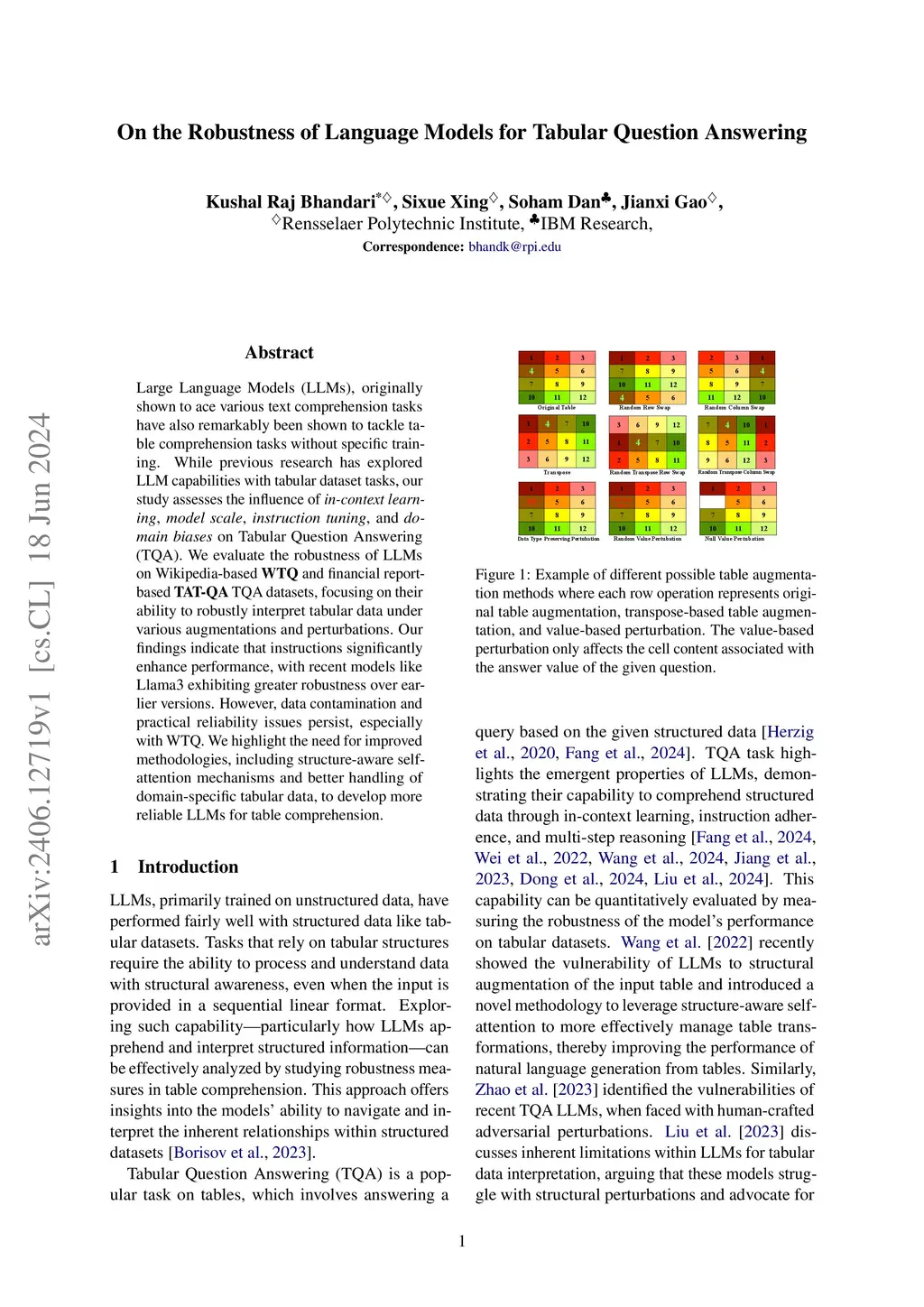
Large Language Models (LLMs), originally shown to ace various text comprehension tasks have also remarkably been shown to tackle table comprehension tasks without specific training. While previous research has explored LLM capabilities with tabular dataset tasks, our study assesses the influence of ,$ \textit{model scale}$, , and on Tabular Question Answering (TQA). We evaluate the robustness of LLMs on Wikipedia-based and financial report-based TQA datasets, focusing on their ability to robustly interpret tabular data under various augmentations and perturbations. Our findings indicate that instructions significantly enhance performance, with recent models like Llama3 exhibiting greater robustness over earlier versions. However, data contamination and practical reliability issues persist, especially with WTQ. We highlight the need for improved methodologies, including structure-aware self-attention mechanisms and better handling of domain-specific tabular data, to develop more reliable LLMs for table comprehension.
View on arXiv