
From Ad Identifiers to Global Privacy Control: The Status Quo and Future of Opting Out of Ad Tracking on Android
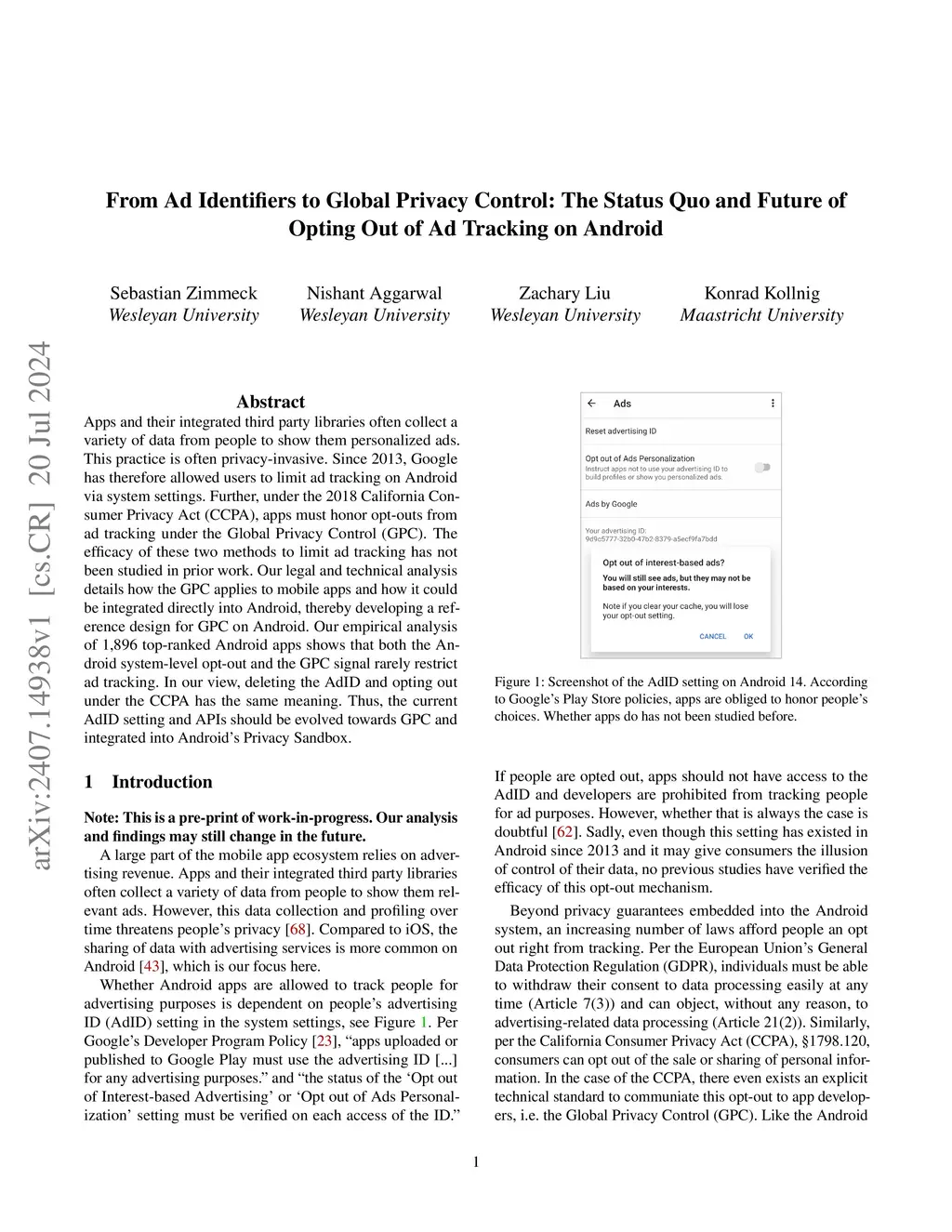
Apps and their integrated third-party libraries often collect personal information from Android users for personalizing ads. This practice can be privacy-invasive. Users can limit ad tracking on Android via the AdID setting; further, the California Consumer Privacy Act (CCPA) gives user an opt-out right via Global Privacy Control (GPC). However, neither of these two privacy controls have been studied before as to whether they help Android users exercise their legally mandated opt-out right. In response, we evaluate how many Android apps are subject to the CCPA opt-out right and find it applicable to approximately 70% of apps on the top free app lists of the US Google Play Store. Our dynamic analysis of 1,811 apps from these lists shows that neither the AdID setting nor GPC effectively prevents the selling and sharing of personal information in California. For example, when disabling the AdID and sending GPC signals to the most common ad tracking domain in our dataset that implements the US Privacy String, only 4% of apps connecting to the domain indicate the opt-out status. To mitigate this shortcoming, Android's AdID setting should be evolved towards a universal GPC setting as part of Google's Privacy Sandbox.
View on arXiv