
Cross-Layer Feature Pyramid Transformer for Small Object Detection in Aerial Images
- ViT
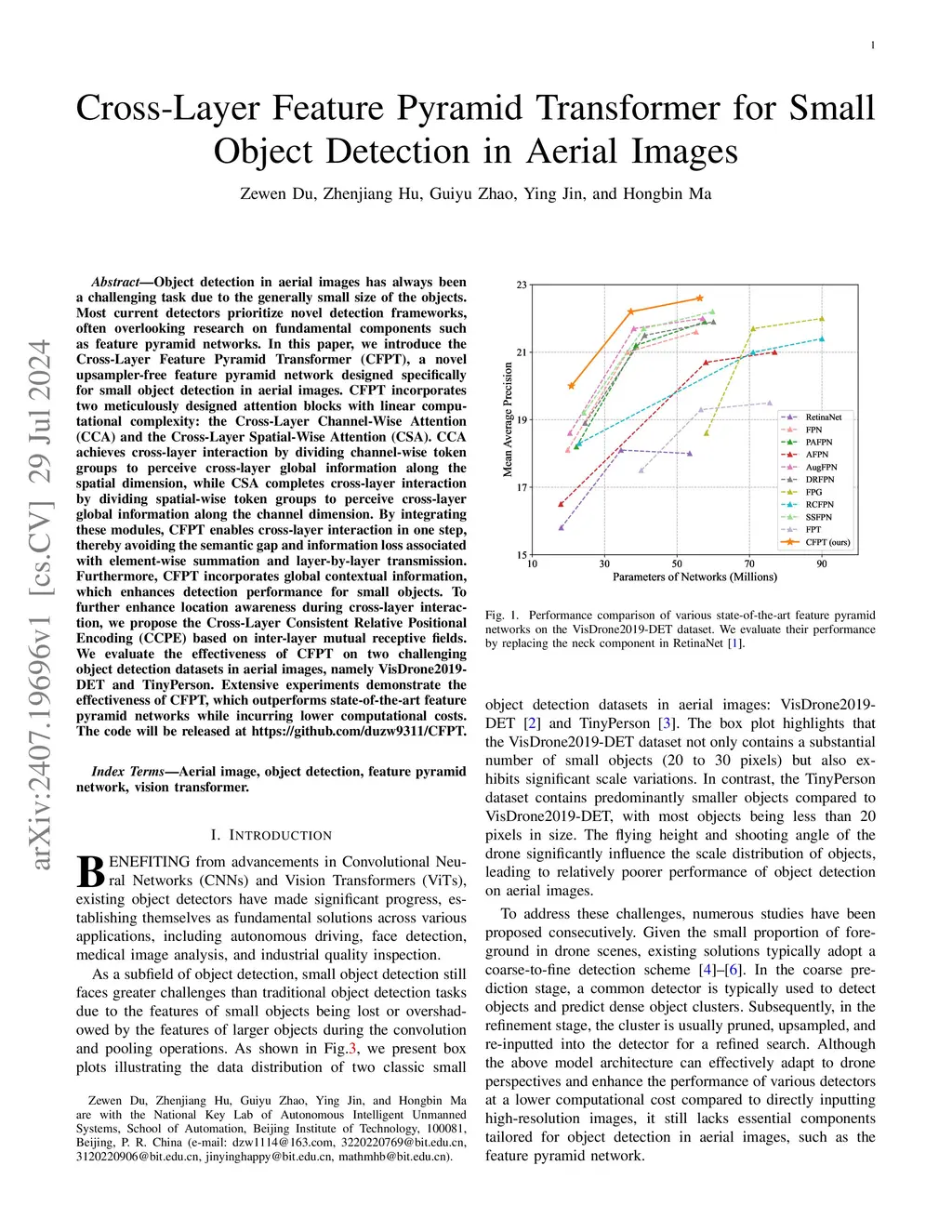
Object detection in aerial images has always been a challenging task due to the generally small size of the objects. Most current detectors prioritize the development of new detection frameworks, often overlooking research on fundamental components such as feature pyramid networks. In this paper, we introduce the Cross-Layer Feature Pyramid Transformer (CFPT), a novel upsampler-free feature pyramid network designed specifically for small object detection in aerial images. CFPT incorporates two meticulously designed attention blocks with linear computational complexity: Cross-Layer Channel-Wise Attention (CCA) and Cross-Layer Spatial-Wise Attention (CSA). CCA achieves cross-layer interaction by dividing channel-wise token groups to perceive cross-layer global information along the spatial dimension, while CSA enables cross-layer interaction by dividing spatial-wise token groups to perceive cross-layer global information along the channel dimension. By integrating these modules, CFPT enables efficient cross-layer interaction in a single step, thereby avoiding the semantic gap and information loss associated with element-wise summation and layer-by-layer transmission. In addition, CFPT incorporates global contextual information, which improves detection performance for small objects. To further enhance location awareness during cross-layer interaction, we propose the Cross-Layer Consistent Relative Positional Encoding (CCPE) based on inter-layer mutual receptive fields. We evaluate the effectiveness of CFPT on three challenging object detection datasets in aerial images: VisDrone2019-DET, TinyPerson, and xView. Extensive experiments demonstrate that CFPT outperforms state-of-the-art feature pyramid networks while incurring lower computational costs. The code is available atthis https URL.
View on arXiv