
Predictive Multiplicity of Knowledge Graph Embeddings in Link Prediction
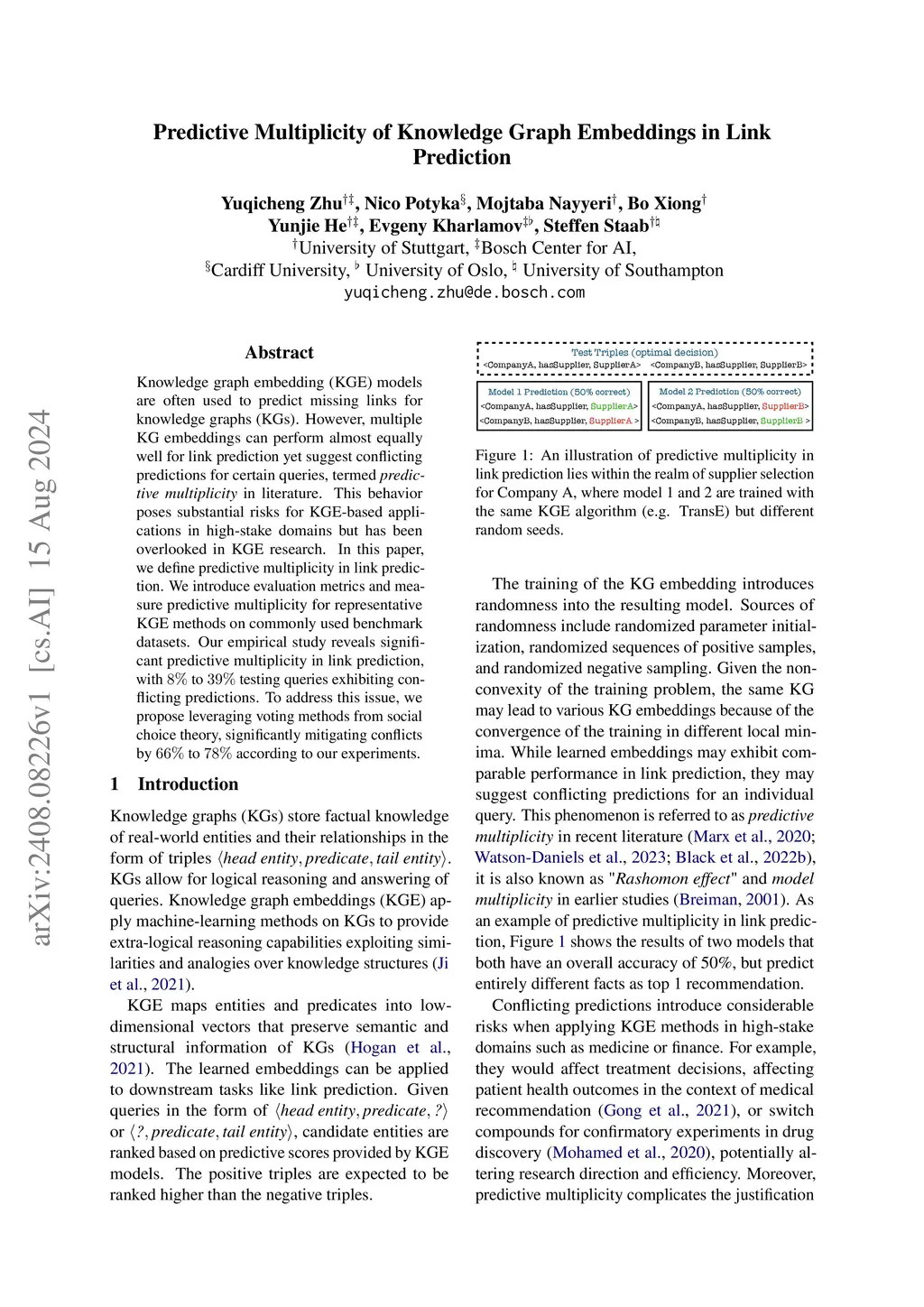
Knowledge graph embedding (KGE) models are often used to predict missing links for knowledge graphs (KGs). However, multiple KG embeddings can perform almost equally well for link prediction yet suggest conflicting predictions for certain queries, termed \textit{predictive multiplicity} in literature. This behavior poses substantial risks for KGE-based applications in high-stake domains but has been overlooked in KGE research. In this paper, we define predictive multiplicity in link prediction. We introduce evaluation metrics and measure predictive multiplicity for representative KGE methods on commonly used benchmark datasets. Our empirical study reveals significant predictive multiplicity in link prediction, with to testing queries exhibiting conflicting predictions. To address this issue, we propose leveraging voting methods from social choice theory, significantly mitigating conflicts by to according to our experiments.
View on arXiv