
Multi-Source EEG Emotion Recognition via Dynamic Contrastive Domain
Adaptation
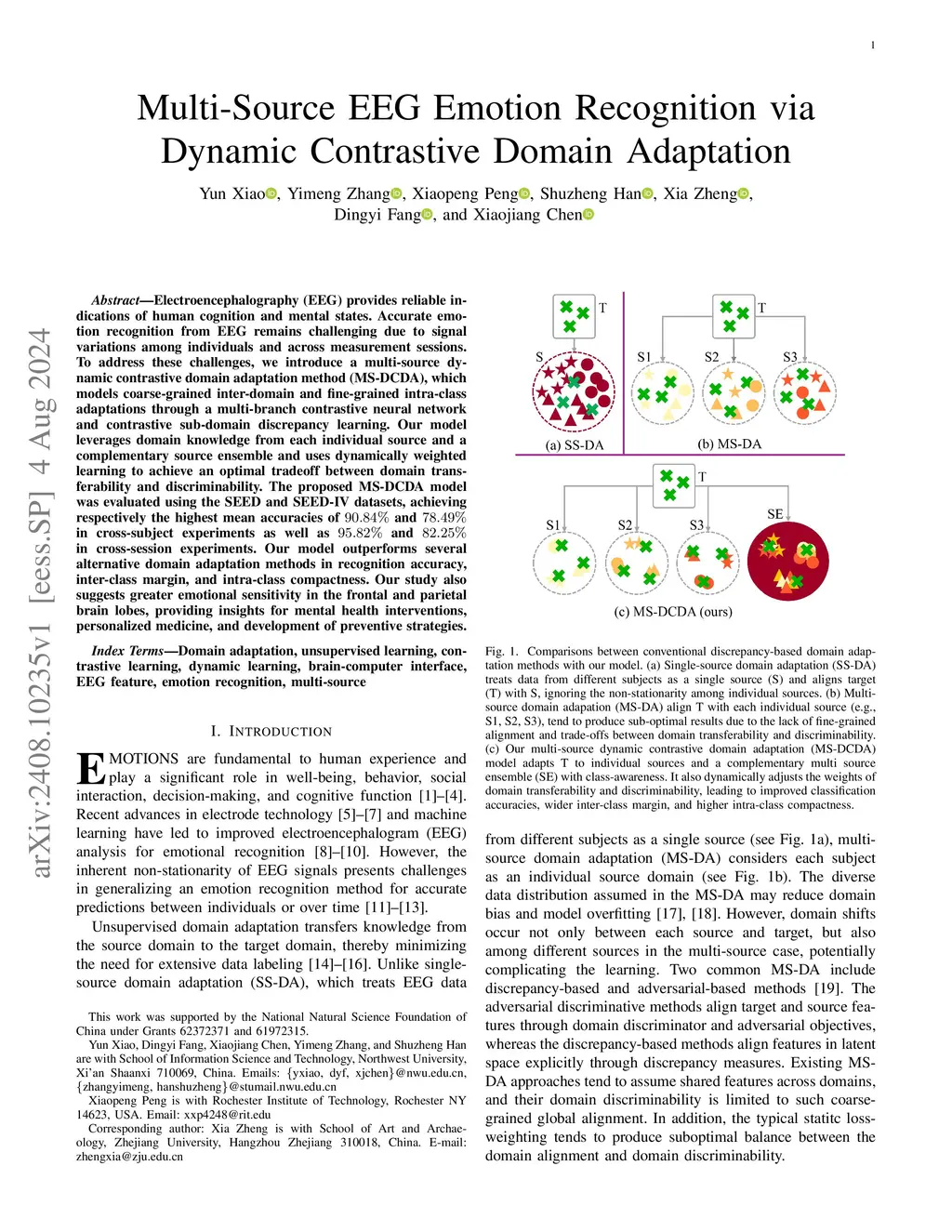
Electroencephalography (EEG) provides reliable indications of human cognition and mental states. Accurate emotion recognition from EEG remains challenging due to signal variations among individuals and across measurement sessions. To address these challenges, we introduce a multi-source dynamic contrastive domain adaptation method (MS-DCDA), which models coarse-grained inter-domain and fine-grained intra-class adaptations through a multi-branch contrastive neural network and contrastive sub-domain discrepancy learning. Our model leverages domain knowledge from each individual source and a complementary source ensemble and uses dynamically weighted learning to achieve an optimal tradeoff between domain transferability and discriminability. The proposed MS-DCDA model was evaluated using the SEED and SEED-IV datasets, achieving respectively the highest mean accuracies of and in cross-subject experiments as well as and in cross-session experiments. Our model outperforms several alternative domain adaptation methods in recognition accuracy, inter-class margin, and intra-class compactness. Our study also suggests greater emotional sensitivity in the frontal and parietal brain lobes, providing insights for mental health interventions, personalized medicine, and development of preventive strategies.
View on arXiv