
Persistent Homology via Ellipsoids
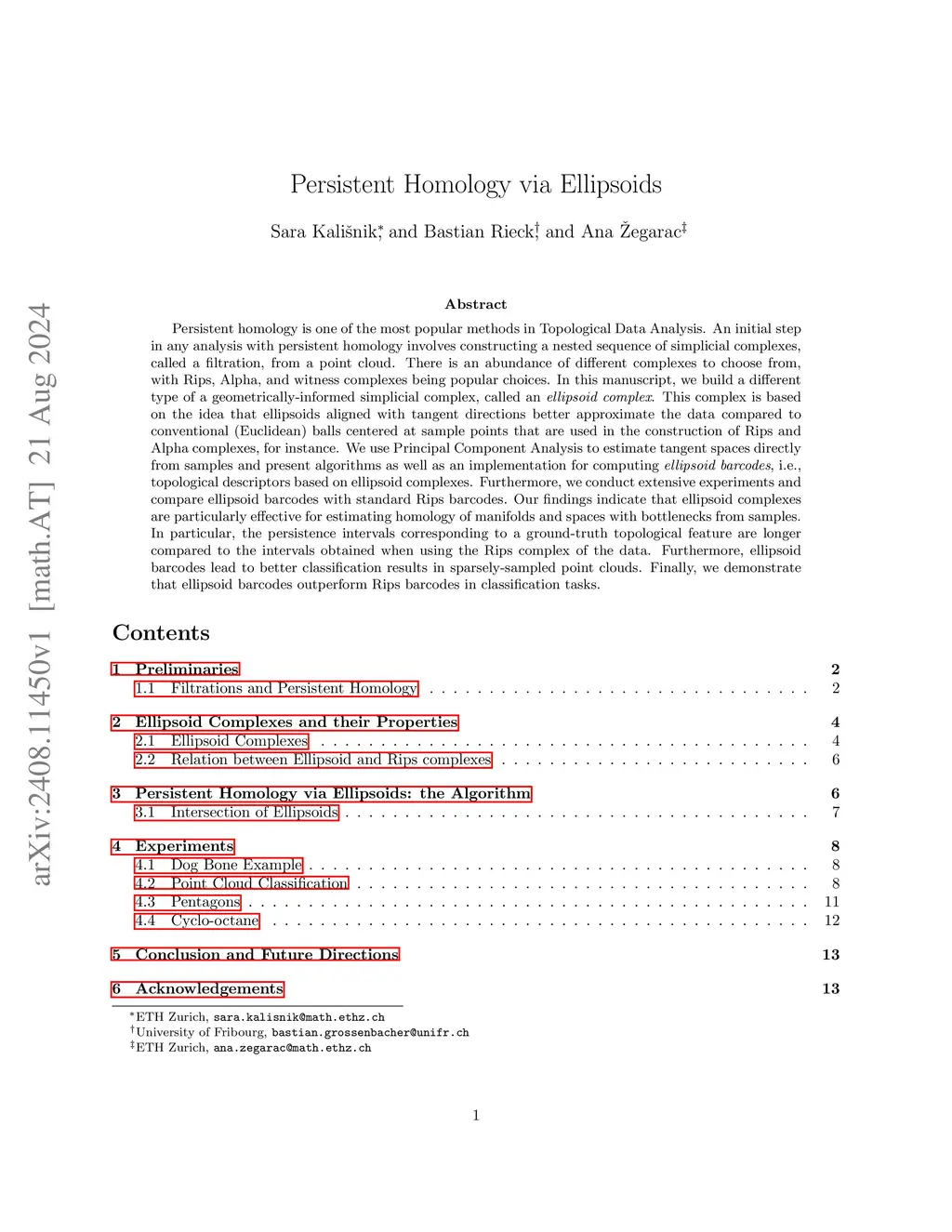
Persistent homology is one of the most popular methods in topological data analysis. An initial step in its use involves constructing a nested sequence of simplicial complexes. There is an abundance of different complexes to choose from, with Čech, Rips, alpha, and witness complexes being popular choices. In this manuscript, we build a novel type of geometrically informed simplicial complex, called a Rips-type ellipsoid complex. This complex is based on the idea that ellipsoids aligned with tangent directions better approximate the data compared to conventional (Euclidean) balls centered at sample points, as used in the construction of Rips and Alpha complexes. We use Principal Component Analysis to estimate tangent spaces directly from samples and present an algorithm for computing Rips-type ellipsoid barcodes, i.e., topological descriptors based on Rips-type ellipsoid complexes. Additionally, we show that the ellipsoid barcodes depend continuously on the input data so that small perturbations of a k-generic point cloud lead to proportionally small changes in the resulting ellipsoid barcodes. This provides a theoretical guarantee analogous, if somewhat weaker, to the classical stability results for Rips and Čech filtrations. We also conduct extensive experiments and compare Rips-type ellipsoid barcodes with standard Rips barcodes. Our findings indicate that Rips-type ellipsoid complexes are particularly effective for estimating the homology of manifolds and spaces with bottlenecks from samples. In particular, the persistence intervals corresponding to ground-truth topological features are longer compared to those obtained using the Rips complex of the data. Furthermore, Rips-type ellipsoid barcodes lead to better classification results in sparsely sampled point clouds. Finally, we demonstrate that Rips-type ellipsoid barcodes outperform Rips barcodes in classification tasks.
View on arXiv