
EmoFace: Emotion-Content Disentangled Speech-Driven 3D Talking Face Animation
- CVBM3DH
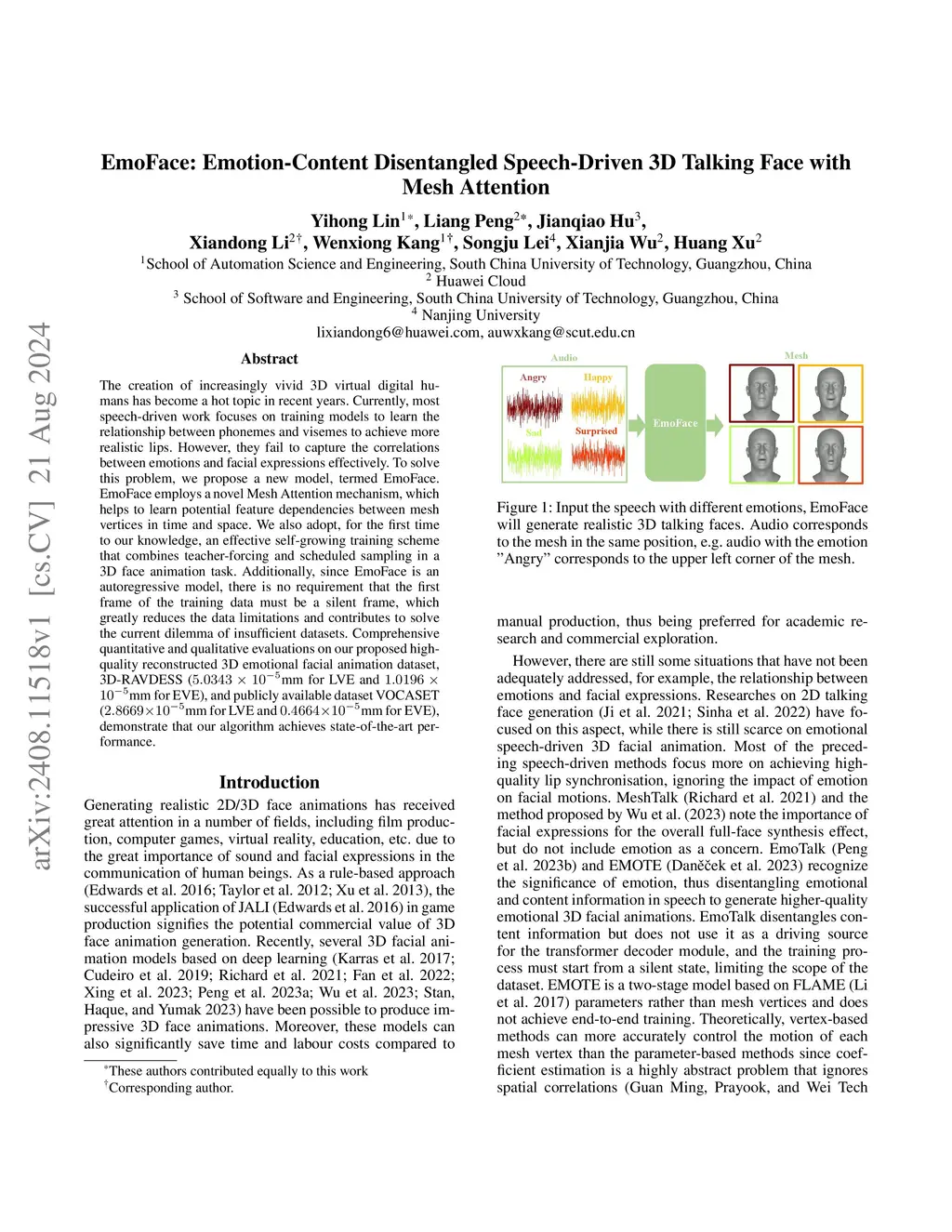
The creation of increasingly vivid 3D talking face has become a hot topic in recent years. Currently, most speech-driven works focus on lip synchronisation but neglect to effectively capture the correlations between emotions and facial motions. To address this problem, we propose a two-stream network called EmoFace, which consists of an emotion branch and a content branch. EmoFace employs a novel Mesh Attention mechanism to analyse and fuse the emotion features and content features. Particularly, a newly designed spatio-temporal graph-based convolution, SpiralConv3D, is used in Mesh Attention to learn potential temporal and spatial feature dependencies between mesh vertices. In addition, to the best of our knowledge, it is the first time to introduce a new self-growing training scheme with intermediate supervision to dynamically adjust the ratio of groundtruth adopted in the 3D face animation task. Comprehensive quantitative and qualitative evaluations on our high-quality 3D emotional facial animation dataset, 3D-RAVDESS (mm for LVE and mm for EVE), together with the public dataset VOCASET (mm for LVE and mm for EVE), demonstrate that our approach achieves state-of-the-art performance.
View on arXiv