
Relaxed Rotational Equivariance via -Biases in Vision
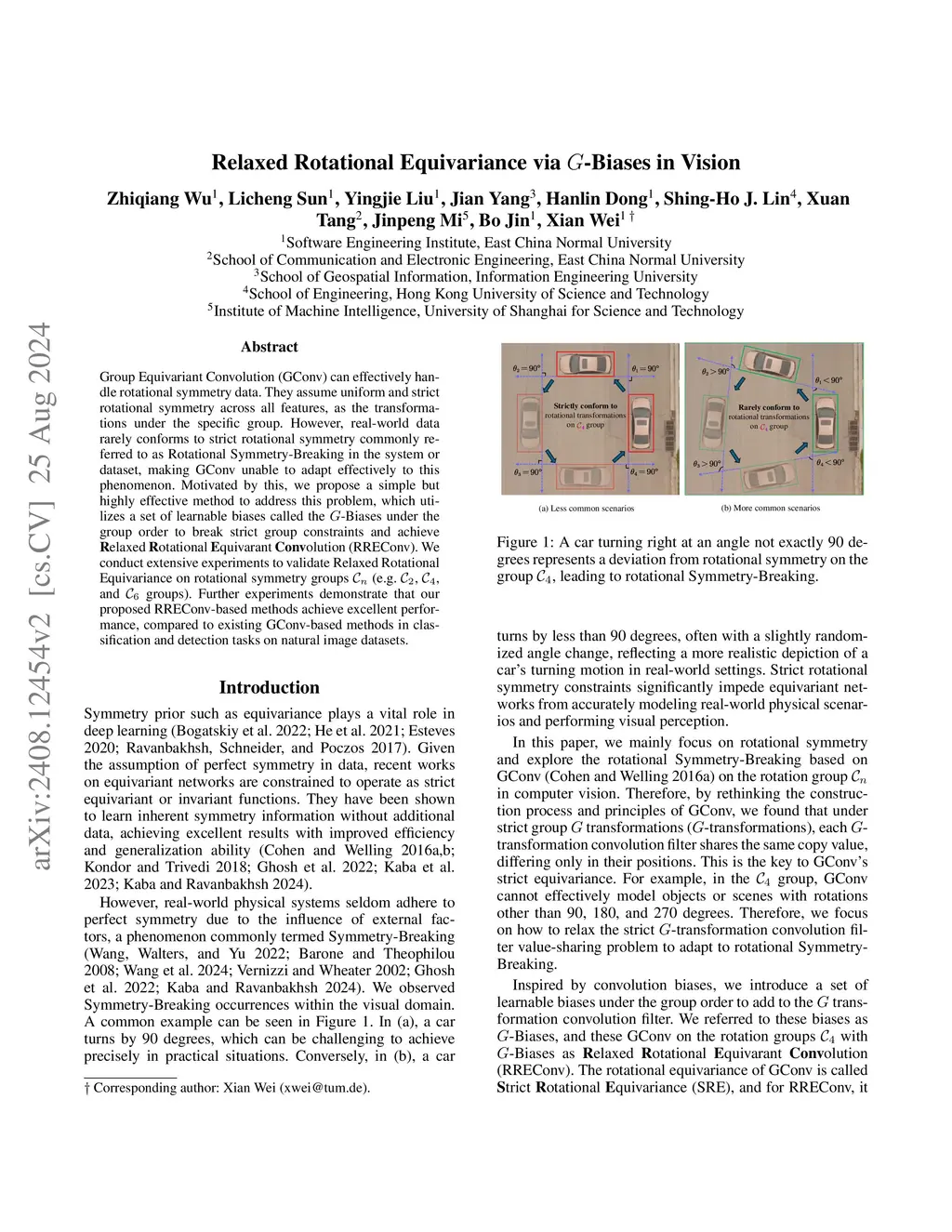
Group Equivariant Convolution (GConv) can effectively handle rotational symmetry data. They assume uniform and strict rotational symmetry across all features, as the transformations under the specific group. However, real-world data rarely conforms to strict rotational symmetry commonly referred to as Rotational Symmetry-Breaking in the system or dataset, making GConv unable to adapt effectively to this phenomenon. Motivated by this, we propose a simple but highly effective method to address this problem, which utilizes a set of learnable biases called the -Biases under the group order to break strict group constraints and achieve \textbf{R}elaxed \textbf{R}otational \textbf{E}quivarant \textbf{Conv}olution (RREConv). We conduct extensive experiments to validate Relaxed Rotational Equivariance on rotational symmetry groups (e.g. , , and groups). Further experiments demonstrate that our proposed RREConv-based methods achieve excellent performance, compared to existing GConv-based methods in classification and detection tasks on natural image datasets.
View on arXiv