
Many-Worlds Inverse Rendering
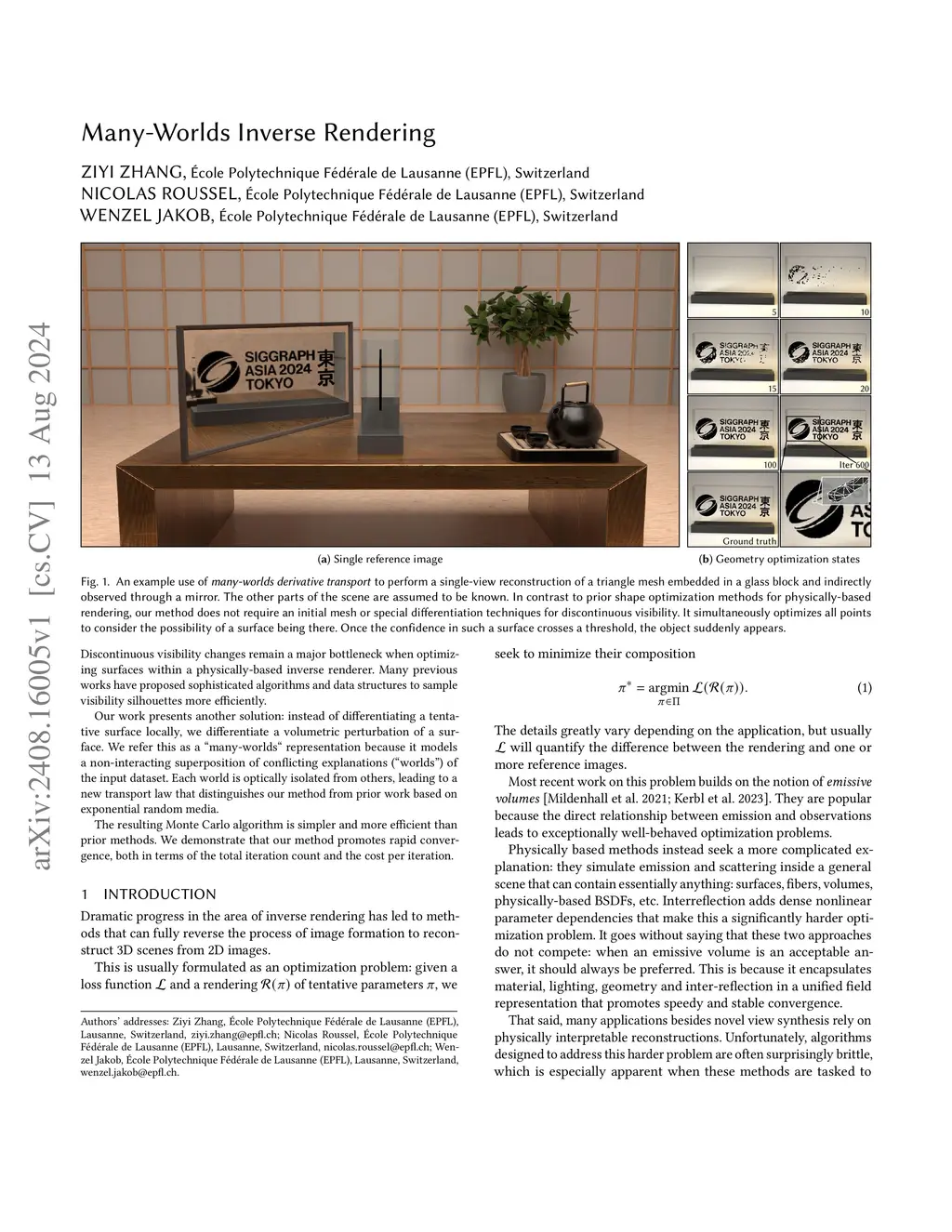
Discontinuous visibility changes remain a major bottleneck when optimizing surfaces within a physically-based inverse renderer. Many previous works have proposed sophisticated algorithms and data structures to sample visibility silhouettes more efficiently.Our work presents another solution: instead of differentiating a tentative surface locally, we differentiate a volumetric perturbation of a surface. We refer this as a many-worlds representation because it models a non-interacting superposition of conflicting explanations (worlds) of the input dataset. Each world is optically isolated from others, leading to a new transport law that distinguishes our method from prior work based on exponential random media.The resulting Monte Carlo algorithm is simpler and more efficient than prior methods. We demonstrate that our method promotes rapid convergence, both in terms of the total iteration count and the cost per iteration.
View on arXiv