
Automatic Detection of LLM-Generated Code: A Comparative Case Study of Contemporary Models Across Function and Class Granularities
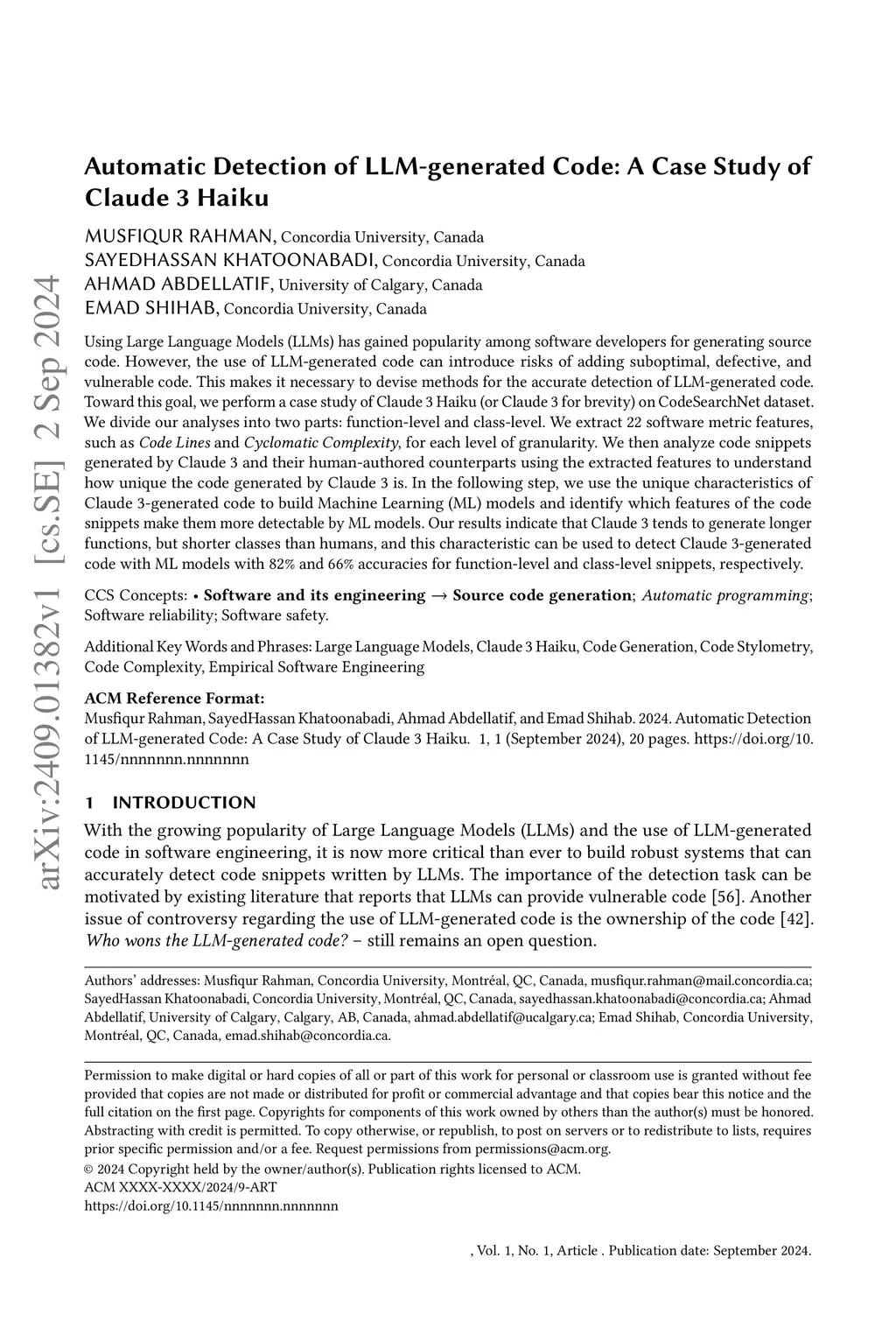
The adoption of Large Language Models (LLMs) for code generation risks incorporating vulnerable code into software systems. Existing detectors face two critical limitations: a lack of systematic cross-model validation and opaque "black box" operation. We address this through a comparative study of code generated by four distinct LLMs: GPT-3.5, Claude 3 Haiku, Claude Haiku 4.5, and GPT-OSS.Analyzing 14,485 Python functions and 11,913 classes from the CodeSearchNet dataset, we generated corresponding code with all four LLMs. Using interpretable software metrics, we trained CatBoost classifiers for each configuration. Our analysis reveals that granularity effects dominate model differences by a factor of 8.6, with negligible feature overlap, indicating that function-level and class-level detection rely on fundamentally disjoint structural signatures.We discover critical granularity-dependent inversions: while modern models (Claude, GPT-OSS) are more detectable at the class level, GPT-3.5 is an anomaly that uniquely excels at the function level. SHAP analysis identifies the Comment-to-Code Ratio as the sole universal discriminator. However, its predictive magnitude varies drastically across models, explaining why detectors trained on specific LLMs fail to generalize.Our findings demonstrate that GPT-3.5's exceptional detectability (AUC-ROC 0.96) is unrepresentative of contemporary models (AUC-ROC approximately between 0.68 and 0.80). Robust detection requires moving beyond single-model studies to account for substantial diversity in structural fingerprints across architectures and granularities.
View on arXiv