
Synthesizing Late-Stage Contrast Enhancement in Breast MRI: A Comprehensive Pipeline Leveraging Temporal Contrast Enhancement Dynamics
- MedIm
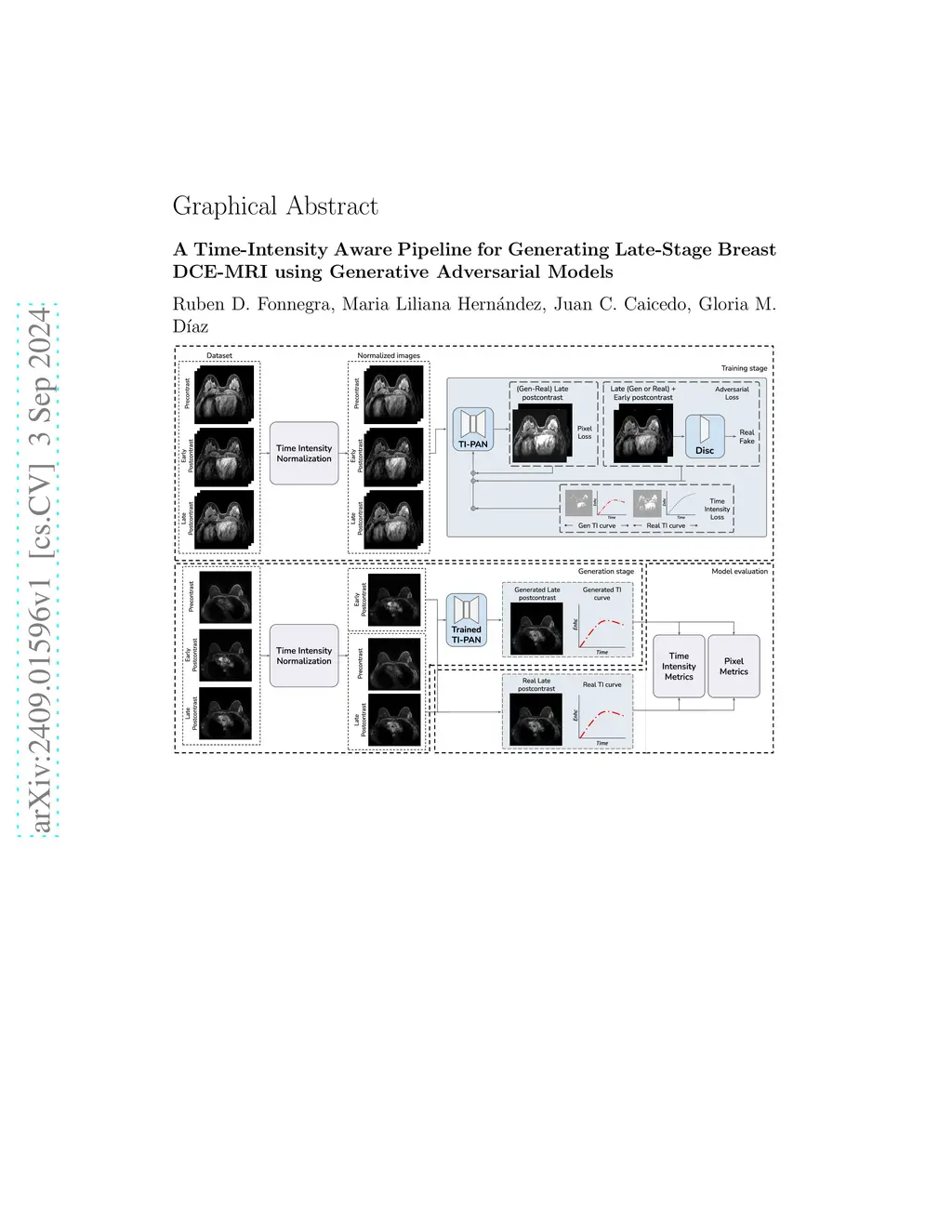
Dynamic contrast-enhanced magnetic resonance imaging (DCE-MRI) is essential for breast cancer diagnosis due to its ability to characterize tissue through contrast agent kinetics. However, traditional DCE-MRI protocols require multiple imaging phases, including early and late post-contrast acquisitions, leading to prolonged scan times, patient discomfort, motion artifacts, high costs, and limited accessibility. To overcome these limitations, this study presents a pipeline for synthesizing late-phase DCE-MRI images from early-phase data, replicating the time-intensity (TI) curve behavior in enhanced regions while maintaining visual fidelity across the entire image. The proposed approach introduces a novel loss function, Time Intensity Loss (TI-loss), leveraging the temporal behavior of contrast agents to guide the training of a generative model. Additionally, a new normalization strategy, TI-norm, preserves the contrast enhancement pattern across multiple image sequences at various timestamps, addressing limitations of conventional normalization methods. Two metrics are proposed to evaluate image quality: the Contrast Agent Pattern Score (), which validates enhancement patterns in annotated regions, and the Average Difference in Enhancement (), measuring differences between real and generated enhancements. Using a public DCE-MRI dataset with 1.5T and 3T scanners, the proposed method demonstrates accurate synthesis of late-phase images that outperform existing models in replicating the TI curve's behavior in regions of interest while preserving overall image quality. This advancement shows a potential to optimize DCE-MRI protocols by reducing scanning time without compromising diagnostic accuracy, and bringing generative models closer to practical implementation in clinical scenarios to enhance efficiency in breast cancer imaging.
View on arXiv