
Learning to Learn Transferable Generative Attack for Person Re-Identification
- AAMLOOD
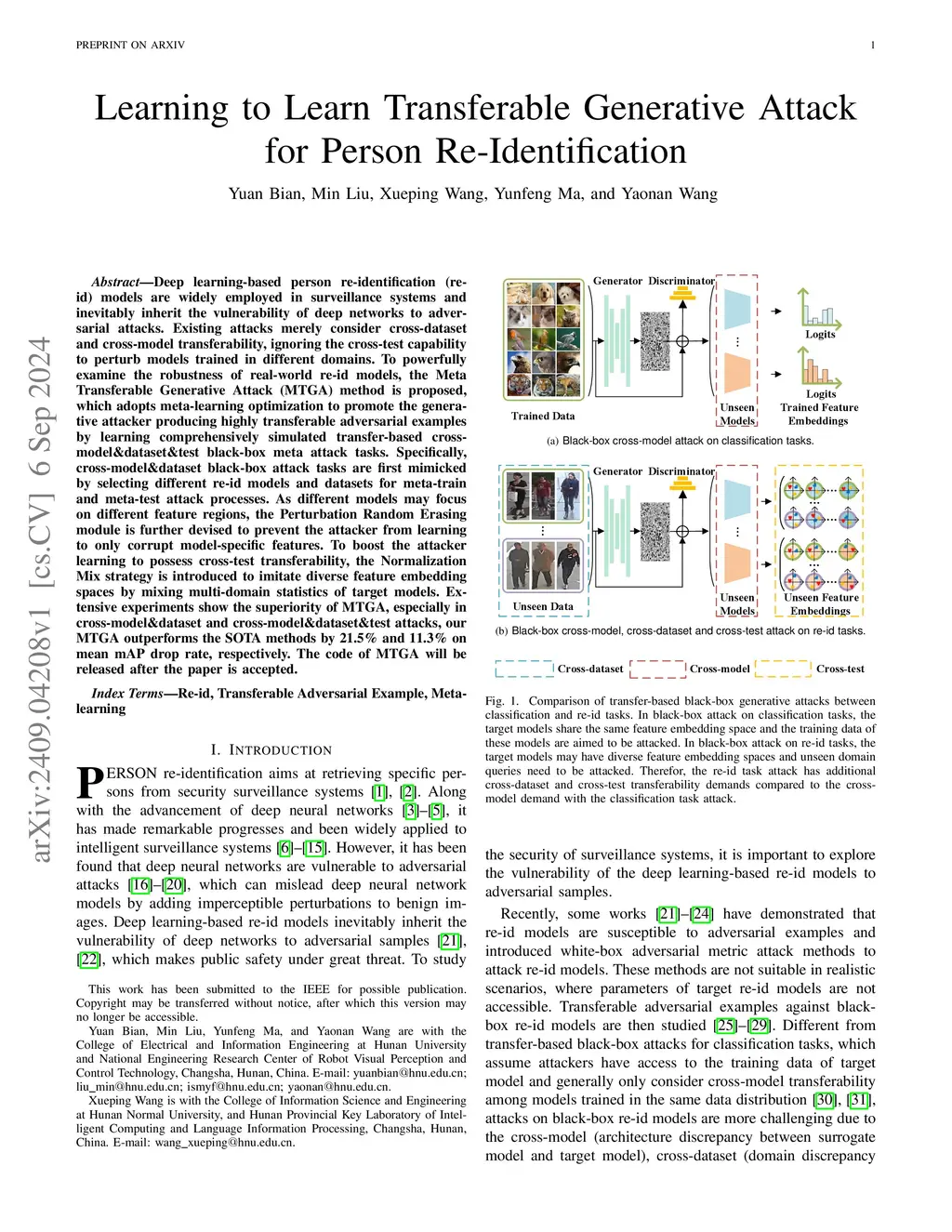
Deep learning-based person re-identification (re-id) models are widely employed in surveillance systems and inevitably inherit the vulnerability of deep networks to adversarial attacks. Existing attacks merely consider cross-dataset and cross-model transferability, ignoring the cross-test capability to perturb models trained in different domains. To powerfully examine the robustness of real-world re-id models, the Meta Transferable Generative Attack (MTGA) method is proposed, which adopts meta-learning optimization to promote the generative attacker producing highly transferable adversarial examples by learning comprehensively simulated transfer-based cross-model\&dataset\&test black-box meta attack tasks. Specifically, cross-model\&dataset black-box attack tasks are first mimicked by selecting different re-id models and datasets for meta-train and meta-test attack processes. As different models may focus on different feature regions, the Perturbation Random Erasing module is further devised to prevent the attacker from learning to only corrupt model-specific features. To boost the attacker learning to possess cross-test transferability, the Normalization Mix strategy is introduced to imitate diverse feature embedding spaces by mixing multi-domain statistics of target models. Extensive experiments show the superiority of MTGA, especially in cross-model\&dataset and cross-model\&dataset\&test attacks, our MTGA outperforms the SOTA methods by 21.5\% and 11.3\% on mean mAP drop rate, respectively. The code of MTGA will be released after the paper is accepted.
View on arXiv