
EgoFSD: Ego-Centric Fully Sparse Paradigm with Uncertainty Denoising and Iterative Refinement for Efficient End-to-End Self-Driving
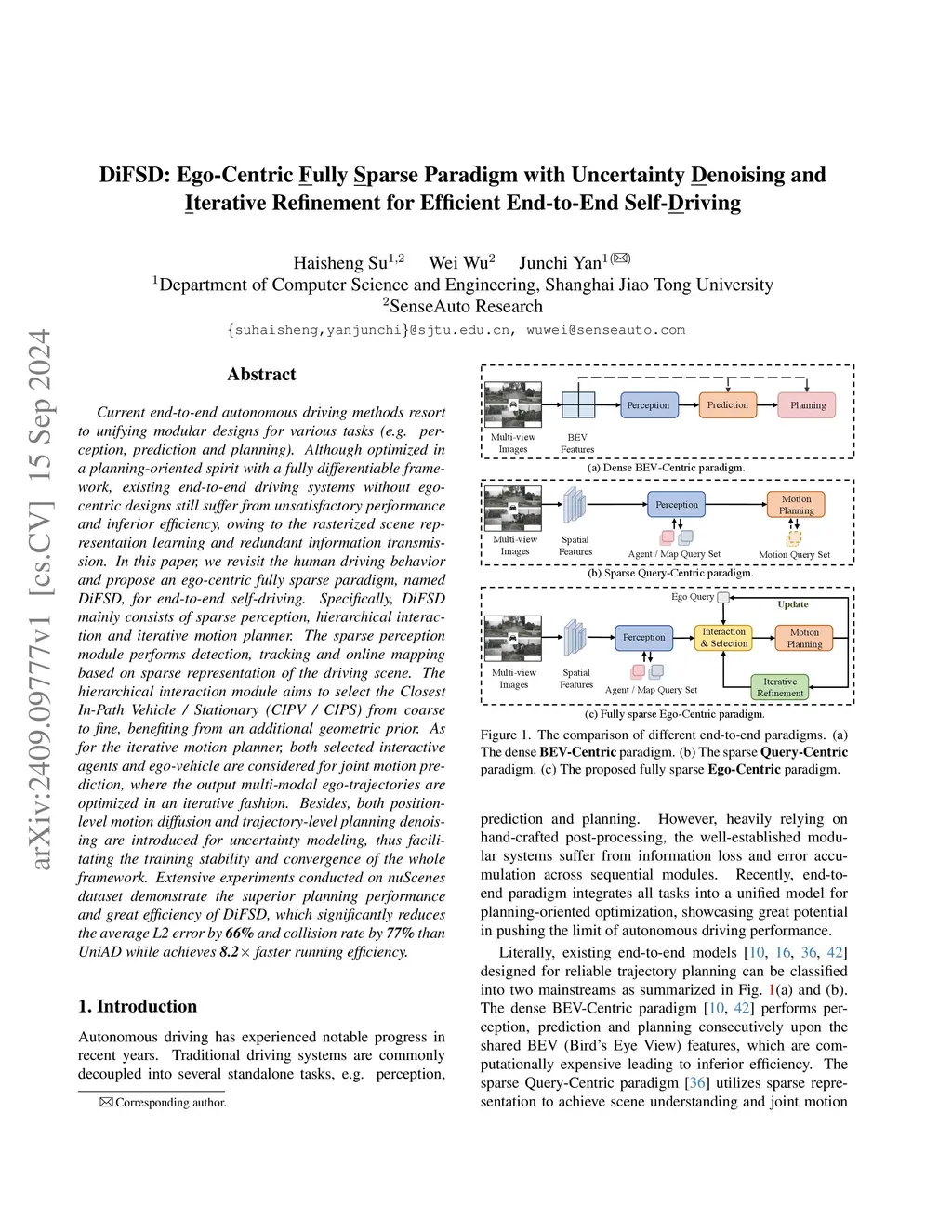
Current End-to-End Autonomous Driving (E2E-AD) methods resort to unifying modular designs for various tasks (e.g. perception, prediction and planning). Although optimized with a fully differentiable framework in a planning-oriented manner, existing end-to-end driving systems lacking ego-centric designs still suffer from unsatisfactory performance and inferior efficiency, due to rasterized scene representation learning and redundant information transmission. In this paper, we propose an ego-centric fully sparse paradigm, named EgoFSD, for end-to-end self-driving. Specifically, EgoFSD consists of sparse perception, hierarchical interaction and iterative motion planner. The sparse perception module performs detection and online mapping based on sparse representation of the driving scene. The hierarchical interaction module aims to select the Closest In-Path Vehicle / Stationary (CIPV / CIPS) from coarse to fine, benefiting from an additional geometric prior. As for the iterative motion planner, both selected interactive agents and ego-vehicle are considered for joint motion prediction, where the output multi-modal ego-trajectories are optimized in an iterative fashion. In addition, position-level motion diffusion and trajectory-level planning denoising are introduced for uncertainty modeling, thereby enhancing the training stability and convergence speed. Extensive experiments are conducted on nuScenes and Bench2Drive datasets, which significantly reduces the average L2 error by 59% and collision rate by 92% than UniAD while achieves 6.9x faster running efficiency.
View on arXiv