
Generation of Uncertainty-Aware High-Level Spatial Concepts in Factorized 3D Scene Graphs via Graph Neural Networks
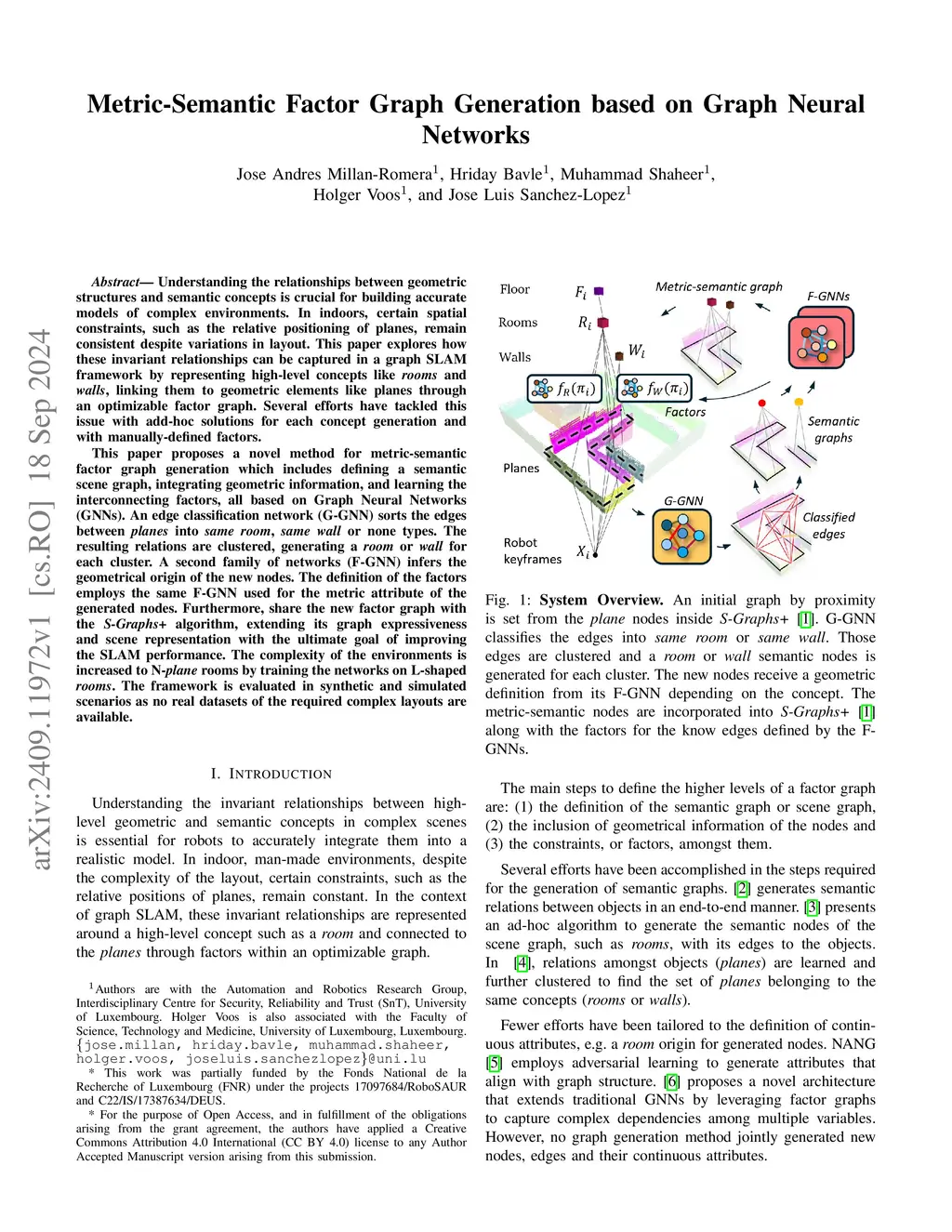
Enabling robots to autonomously discover high-level spatial concepts (e.g., rooms and walls) from primitive geometric observations (e.g., planar surfaces) within 3D Scene Graphs is essential for robust indoor navigation and mapping. These graphs provide a hierarchical metric-semantic representation in which such concepts are organized. To further enhance graph-SLAM performance, Factorized 3D Scene Graphs incorporate these concepts as optimization factors that constrain relative geometry and enforce global consistency. However, both stages of this process remain largely manual: concepts are typically derived using hand-crafted, concept-specific heuristics, while factors and their covariances are likewise manually designed. This reliance on manual specification limits generalization across diverse environments and scalability to new concept classes.This paper presents a novel learning-based method that infers spatial concepts online from observed vertical planes and introduces them as optimizable factors within a SLAM backend, eliminating the need to handcraft concept generation, factor design, and covariance specification. We evaluate our approach in simulated environments with complex layouts, improving room detection by 20.7% and trajectory estimation by 19.2%, and further validate it on real construction sites, where room detection improves by 5.3% and map matching accuracy by 3.8%. Results confirm that learned factors can improve their handcrafted counterparts in SLAM systems and serve as a foundation for extending this approach to new spatial concepts.
View on arXiv