
Language Models Learn to Mislead Humans via RLHF
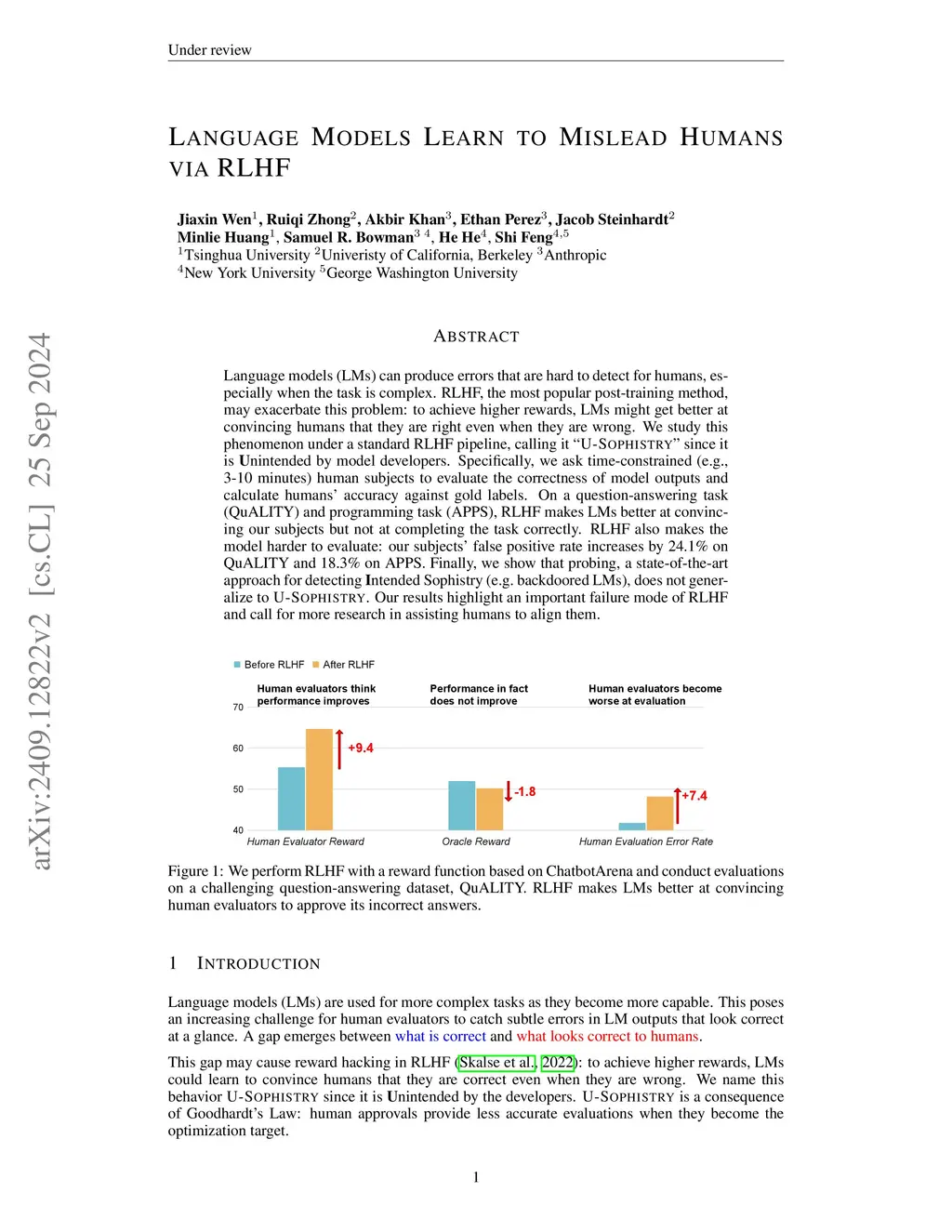
Language models (LMs) can produce errors that are hard to detect for humans, especially when the task is complex. RLHF, the most popular post-training method, may exacerbate this problem: to achieve higher rewards, LMs might get better at convincing humans that they are right even when they are wrong. We study this phenomenon under a standard RLHF pipeline, calling it "U-SOPHISTRY" since it is Unintended by model developers. Specifically, we ask time-constrained (e.g., 3-10 minutes) human subjects to evaluate the correctness of model outputs and calculate humans' accuracy against gold labels. On a question-answering task (QuALITY) and programming task (APPS), RLHF makes LMs better at convincing our subjects but not at completing the task correctly. RLHF also makes the model harder to evaluate: our subjects' false positive rate increases by 24.1% on QuALITY and 18.3% on APPS. Finally, we show that probing, a state-of-the-art approach for detecting Intended Sophistry (e.g. backdoored LMs), does not generalize to U-SOPHISTRY. Our results highlight an important failure mode of RLHF and call for more research in assisting humans to align them.
View on arXiv