
CamLoPA: A Hidden Wireless Camera Localization Framework via Signal
Propagation Path Analysis
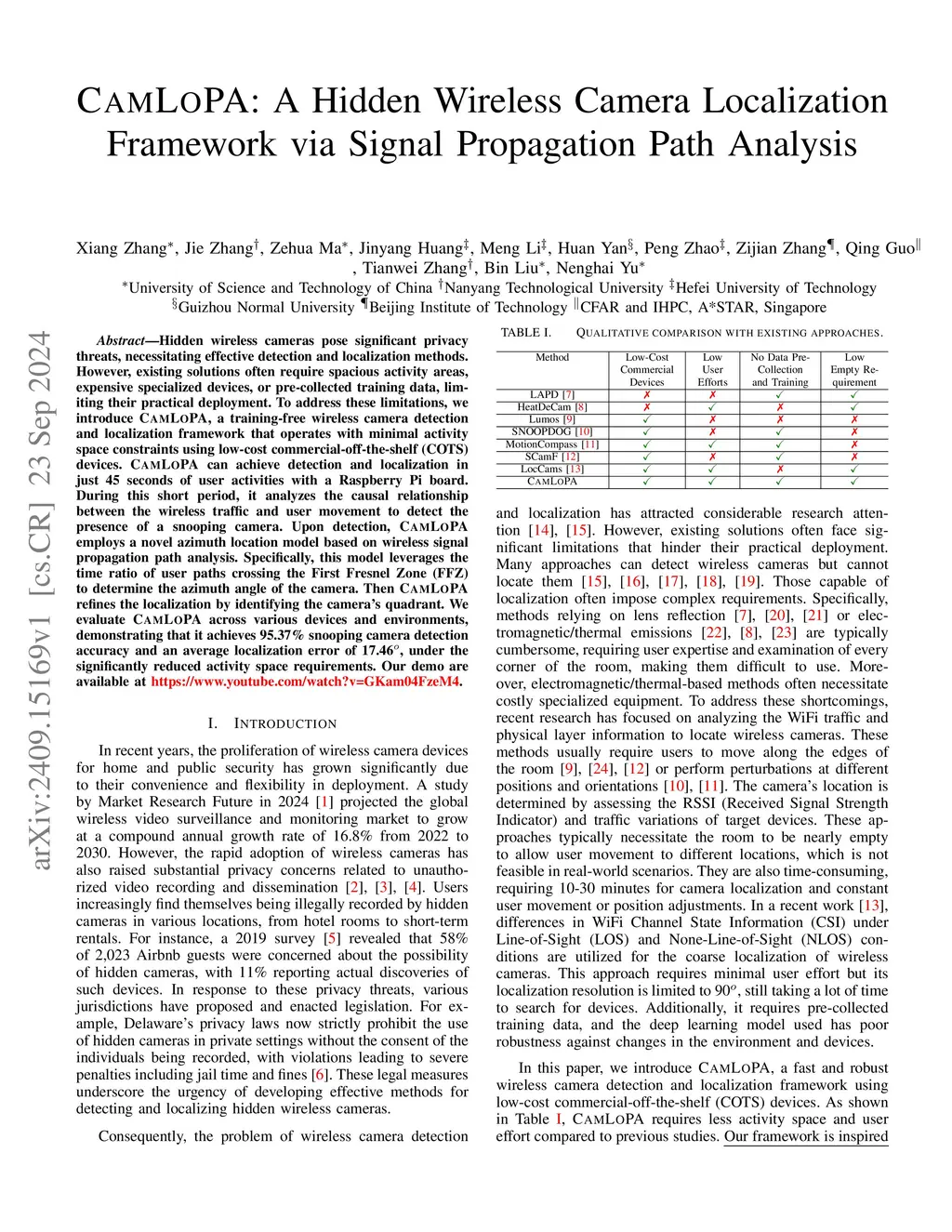
Hidden wireless cameras pose significant privacy threats, necessitating effective detection and localization methods. However, existing solutions often require spacious activity areas, expensive specialized devices, or pre-collected training data, limiting their practical deployment. To address these limitations, we introduce CamLoPA, a training-free wireless camera detection and localization framework that operates with minimal activity space constraints using low-cost commercial-off-the-shelf (COTS) devices. CamLoPA can achieve detection and localization in just 45 seconds of user activities with a Raspberry Pi board. During this short period, it analyzes the causal relationship between the wireless traffic and user movement to detect the presence of a snooping camera. Upon detection, CamLoPA employs a novel azimuth location model based on wireless signal propagation path analysis. Specifically, this model leverages the time ratio of user paths crossing the First Fresnel Zone (FFZ) to determine the azimuth angle of the camera. Then CamLoPA refines the localization by identifying the camera's quadrant. We evaluate CamLoPA across various devices and environments, demonstrating that it achieves 95.37% snooping camera detection accuracy and an average localization error of 17.23, under the significantly reduced activity space requirements. Our demo are available at https://www.youtube.com/watch?v=GKam04FzeM4.
View on arXiv