
EfficientCrackNet: A Lightweight Model for Crack Segmentation
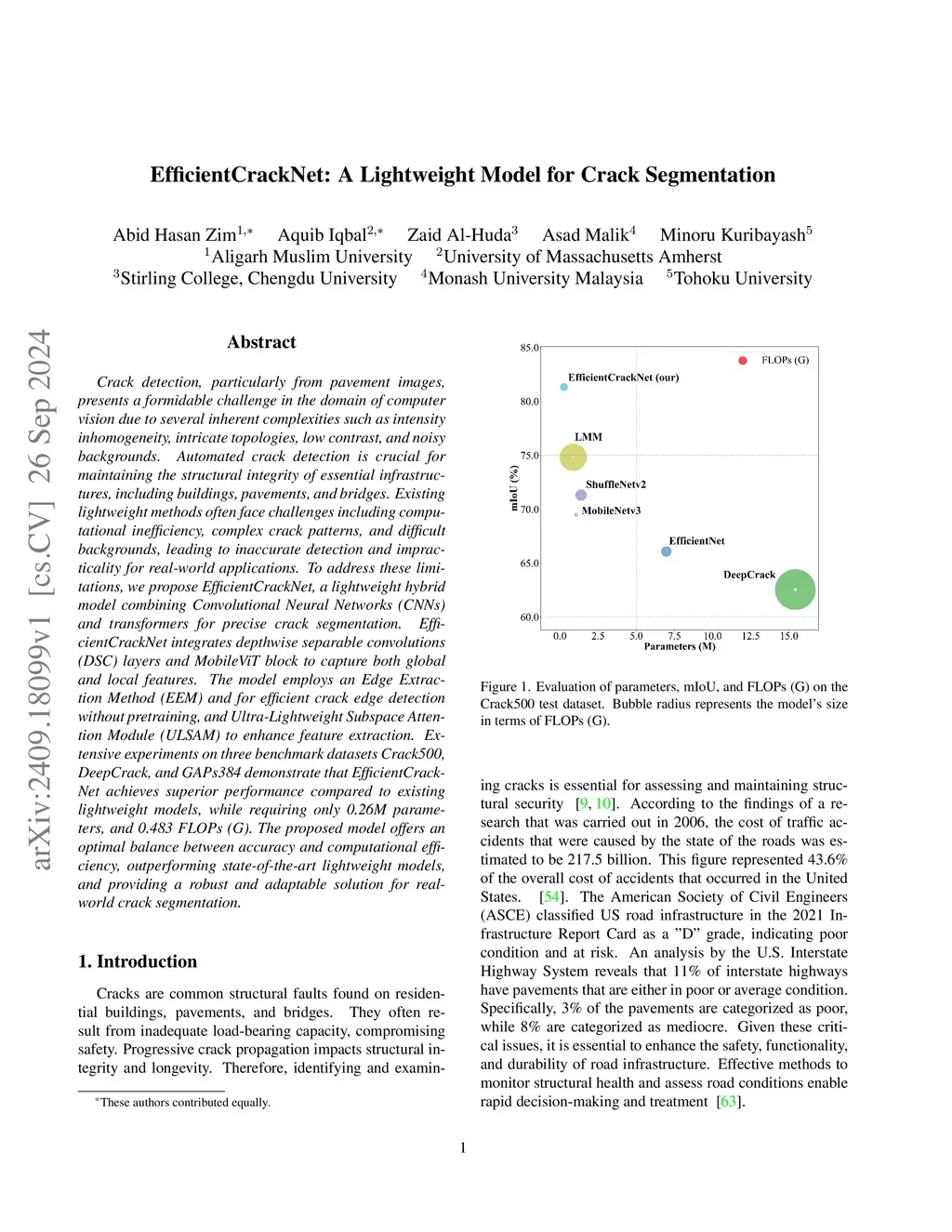
Crack detection, particularly from pavement images, presents a formidable challenge in the domain of computer vision due to several inherent complexities such as intensity inhomogeneity, intricate topologies, low contrast, and noisy backgrounds. Automated crack detection is crucial for maintaining the structural integrity of essential infrastructures, including buildings, pavements, and bridges. Existing lightweight methods often face challenges including computational inefficiency, complex crack patterns, and difficult backgrounds, leading to inaccurate detection and impracticality for real-world applications. To address these limitations, we propose EfficientCrackNet, a lightweight hybrid model combining Convolutional Neural Networks (CNNs) and transformers for precise crack segmentation. EfficientCrackNet integrates depthwise separable convolutions (DSC) layers and MobileViT block to capture both global and local features. The model employs an Edge Extraction Method (EEM) and for efficient crack edge detection without pretraining, and Ultra-Lightweight Subspace Attention Module (ULSAM) to enhance feature extraction. Extensive experiments on three benchmark datasets Crack500, DeepCrack, and GAPs384 demonstrate that EfficientCrackNet achieves superior performance compared to existing lightweight models, while requiring only 0.26M parameters, and 0.483 FLOPs (G). The proposed model offers an optimal balance between accuracy and computational efficiency, outperforming state-of-the-art lightweight models, and providing a robust and adaptable solution for real-world crack segmentation.
View on arXiv