
Learning with Less: Optimizing Tactile Sensor Configurations for Dexterous Manipulation
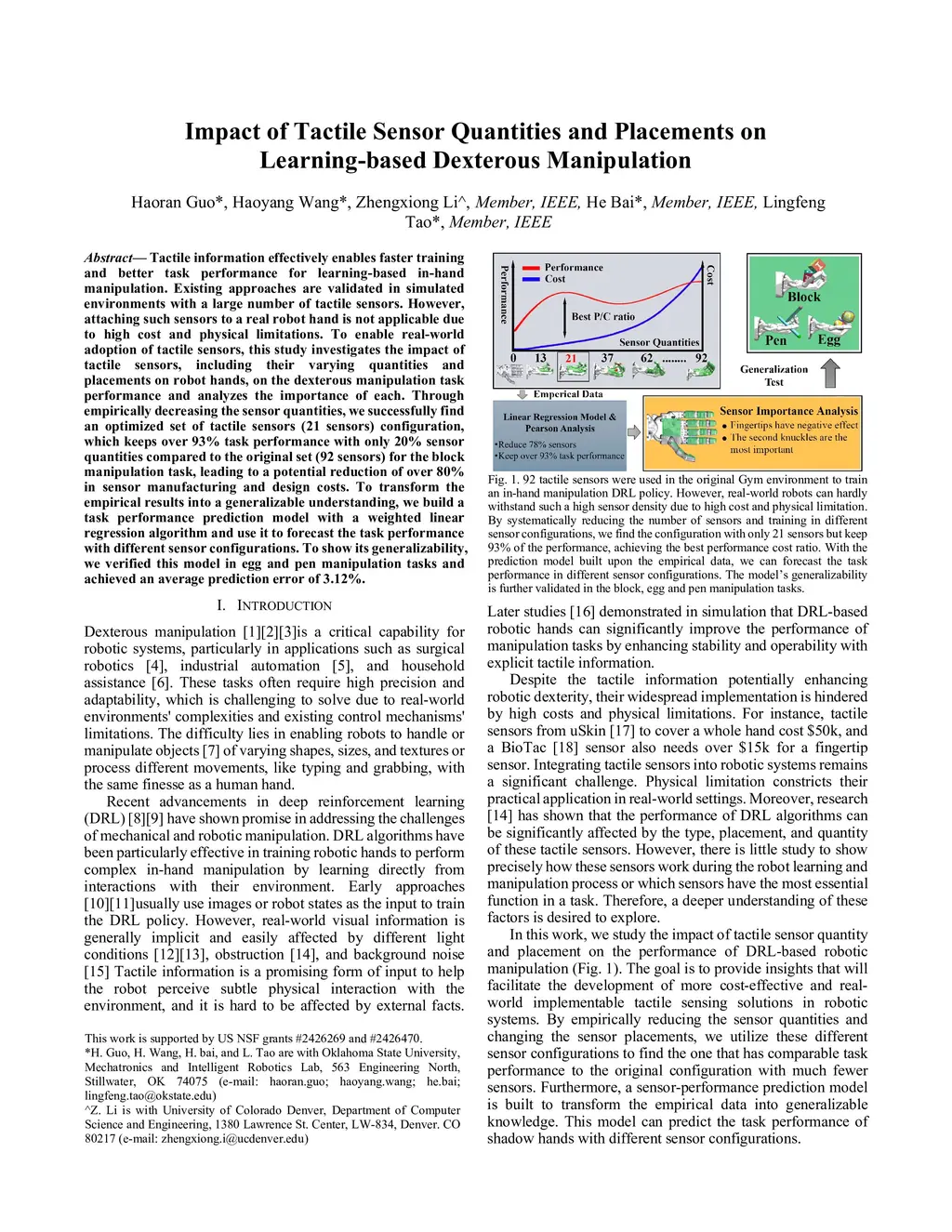
Tactile sensing is critical for learning-based robotic dexterous manipulation, enabling real-time force perception, slip detection, and grip adjustments during interactions. While full-hand sensor arrays provide precise control, their deployment is limited by high costs, complex integration, and significant computational demands. Practical constraints, including limited space and the complexity of the wiring, further restrict the use of the entire sensor. Consequently, optimizing sensor configurations to achieve efficient coverage and good performance using fewer sensors remains a significant and open researchthis http URLthis work, we investigate the influence of tactile sensor quantity and placement on a robotic hand for dexterous manipulation tasks. Through systematic analysis of various sensor configurations, an optimized layout with only 21 sensors is identified, achieving over 93% of the task success rate relative to full-hand coverage (92 sensors). This configuration reduces the sensor count by 77% and offers a considerable reduction in integration costs, demonstrating a cost-effective yet high-performing tactile sensing strategy. Additionally, we develop a multi-factor regression model to predict task success rate under arbitrary sensor configurations. The model achieves strong generalization, with an average prediction error of 3.12% on unseen manipulation tasks. These results offer a scalable framework for deploying tactile sensing in real-world robotic manipulation systems.
View on arXiv