
Robust Modality-incomplete Anomaly Detection: A Modality-instructive Framework with Benchmark
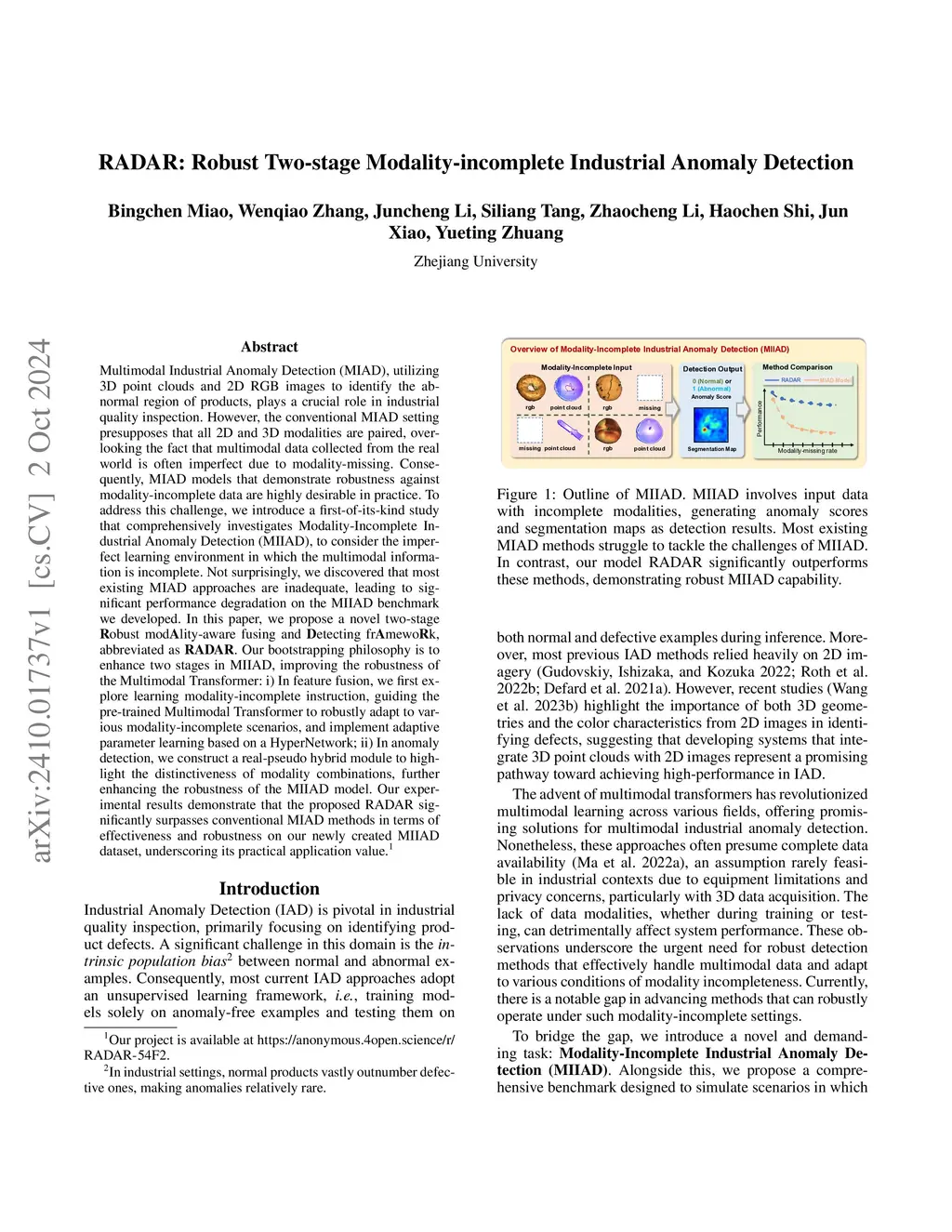
Multimodal Industrial Anomaly Detection (MIAD), which utilizes 3D point clouds and 2D RGB images to identify abnormal regions in products, plays a crucial role in industrial quality inspection. However, traditional MIAD settings assume that all 2D and 3D modalities are paired, ignoring the fact that multimodal data collected from the real world is often imperfect due to missing modalities. Additionally, models trained on modality-incomplete data are prone to overfitting. Therefore, MIAD models that demonstrate robustness against modality-incomplete data are highly desirable in practice. To address this, we introduce a pioneering study that comprehensively investigates Modality-Incomplete Industrial Anomaly Detection (MIIAD), and under the guidance of experts, we construct the MIIAD Bench with rich modality-missing settings to account for imperfect learning environments with incomplete multimodal information. As expected, we find that most existing MIAD methods perform poorly on the MIIAD Bench, leading to significant performance degradation. To tackle this challenge, we propose a novel two-stage Robust modAlity-aware fusing and Detecting framewoRk, abbreviated as RADAR. Specifically: i) We propose Modality-incomplete Instruction to guide the multimodal Transformer to robustly adapt to various modality-incomplete scenarios, and implement adaptive parameter learning based on HyperNetwork. ii) Then, we construct a Double-Pseudo Hybrid Module to highlight the uniqueness of modality combinations, mitigating overfitting issues and further enhancing the robustness of the MIIAD model. Our experimental results demonstrate that the proposed RADAR significantly outperforms traditional MIAD methods on our newly created MIIAD dataset, proving its practical application value.
View on arXiv