
Extremum Seeking Controlled Wiggling for Tactile Insertion
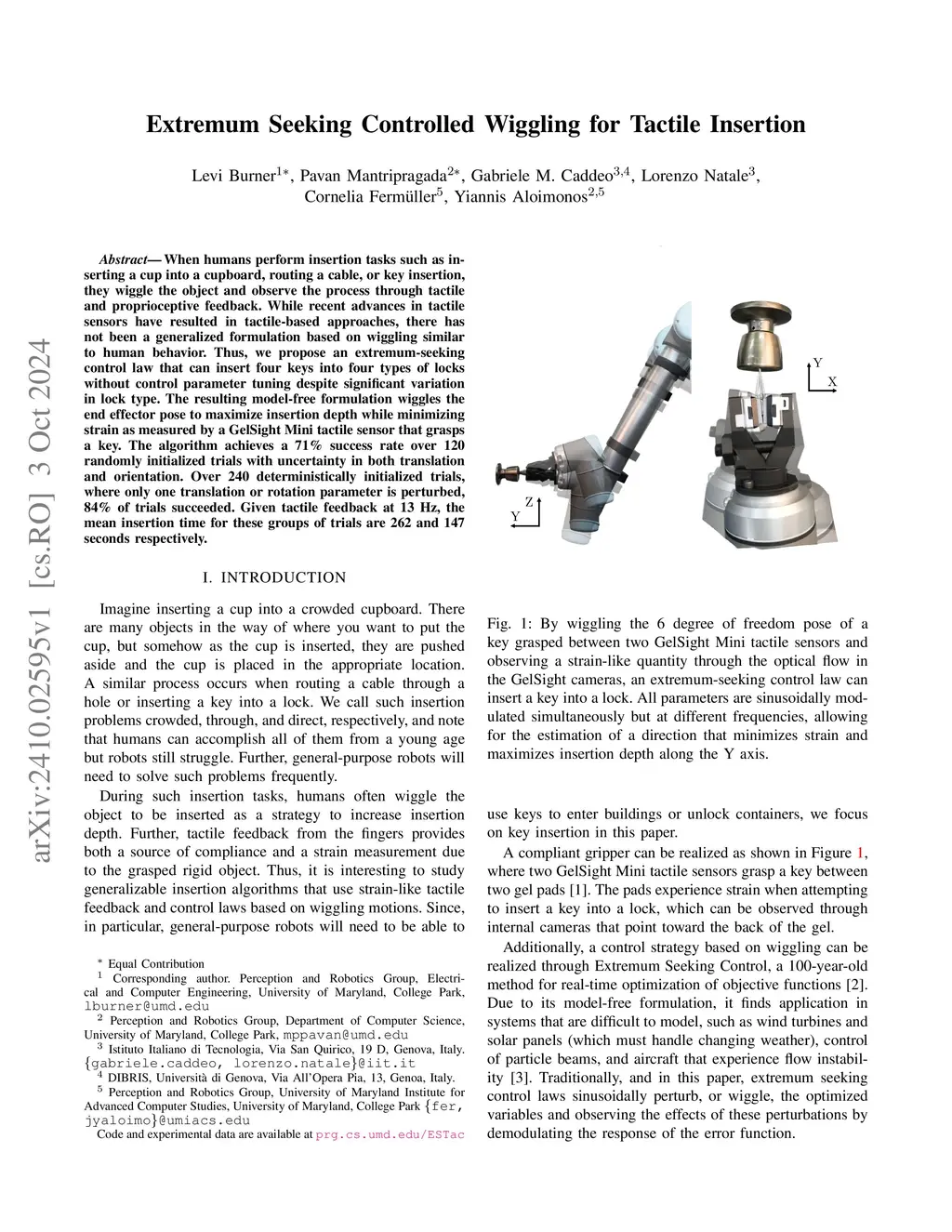
When humans perform complex insertion tasks such as pushing a cup into a cupboard, routing a cable, or putting a key in a lock, they wiggle the object and adapt the process through tactile feedback. A similar robotic approach has not been developed. We study an extremum seeking control law that wiggles end effector pose to maximize insertion depth while minimizing strain measured by a GelSight Mini sensor. Evaluation is conducted on four keys featuring complex geometry and five assembly tasks featuring basic geometry.On keys, the algorithm achieves 71% success rate over 120 trials with 6-DOF perturbations, 84% over 240 trials with 1-DOF perturbations, and 75% over 40 trials initialized with vision. It significantly outperforms a baseline optimizer, CMA-ES, that replaces wiggling with random sampling. When tested on a state-of-the-art assembly benchmark featuring basic geometry, it achieves 98% over 50 vision-initialized trials. The benchmark's most similar baseline, which was trained on the objects, achieved 86%. These results, realized without contact modeling or learning, show that closed loop wiggling based on tactile feedback is a robust paradigm for robotic insertion.
View on arXiv