
On Logical Extrapolation for Mazes with Recurrent and Implicit Networks
- LRM
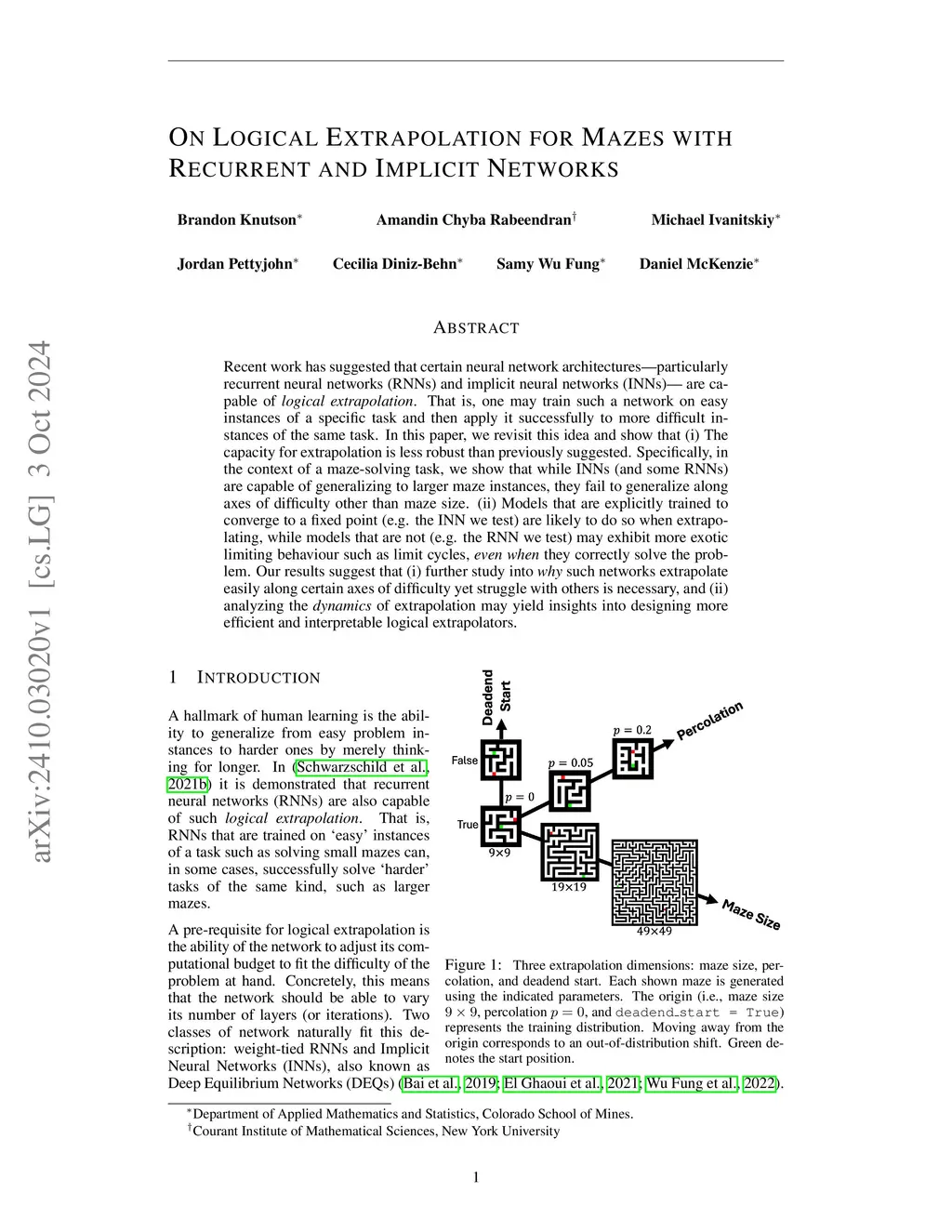
Recent work suggests that certain neural network architectures -- particularly recurrent neural networks (RNNs) and implicit neural networks (INNs) -- are capable of logical extrapolation. When trained on easy instances of a task, these networks (henceforth: logical extrapolators) can generalize to more difficult instances. Previous research has hypothesized that logical extrapolators do so by learning a scalable, iterative algorithm for the given task which converges to the solution. We examine this idea more closely in the context of a single task: maze solving. By varying test data along multiple axes -- not just maze size -- we show that models introduced in prior work fail in a variety of ways, some expected and others less so. It remains uncertain whether any of these models has truly learned an algorithm. However, we provide evidence that a certain RNN has approximately learned a form of `deadend-filling'. We show that training these models on more diverse data addresses some failure modes but, paradoxically, does not improve logical extrapolation. We also analyze convergence behavior, and show that models explicitly trained to converge to a fixed point are likely to do so when extrapolating, while models that are not may exhibit more exotic limiting behavior such as limit cycles, even when they correctly solve the problem. Our results (i) show that logical extrapolation is not immune to the problem of goal misgeneralization, and (ii) suggest that analyzing the dynamics of extrapolation may yield insights into designing better logical extrapolators.
View on arXiv