
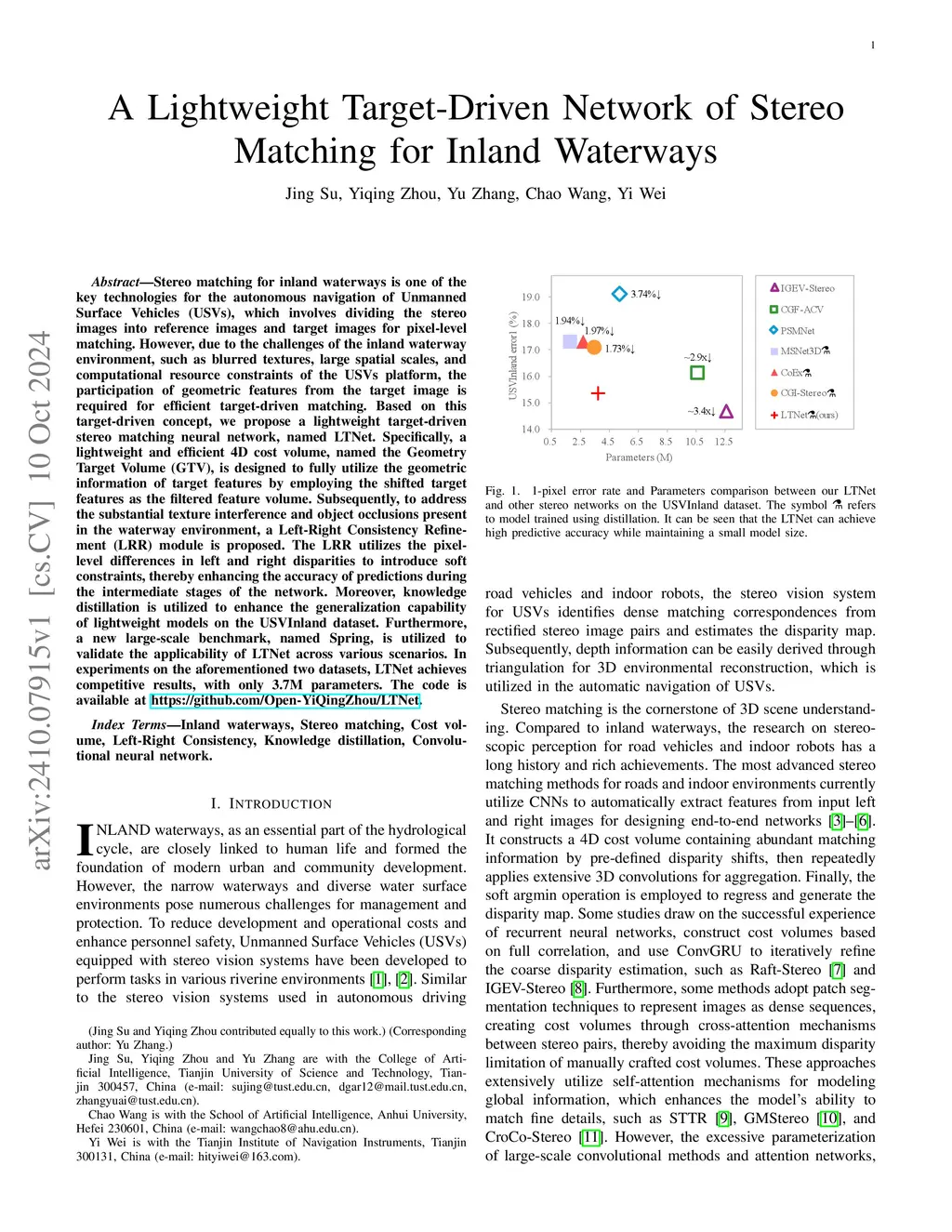
Stereo matching for inland waterways is one of the key technologies for the autonomous navigation of Unmanned Surface Vehicles (USVs), which involves dividing the stereo images into reference images and target images for pixel-level matching. However, due to the challenges of the inland waterway environment, such as blurred textures, large spatial scales, and computational resource constraints of the USVs platform, the participation of geometric features from the target image is required for efficient target-driven matching. Based on this target-driven concept, we propose a lightweight target-driven stereo matching neural network, named LTNet. Specifically, a lightweight and efficient 4D cost volume, named the Geometry Target Volume (GTV), is designed to fully utilize the geometric information of target features by employing the shifted target features as the filtered feature volume. Subsequently, to address the substantial texture interference and object occlusions present in the waterway environment, a Left-Right Consistency Refinement (LRR) module is proposed. The \text{LRR} utilizes the pixel-level differences in left and right disparities to introduce soft constraints, thereby enhancing the accuracy of predictions during the intermediate stages of the network. Moreover, knowledge distillation is utilized to enhance the generalization capability of lightweight models on the USVInland dataset. Furthermore, a new large-scale benchmark, named Spring, is utilized to validate the applicability of LTNet across various scenarios. In experiments on the aforementioned two datasets, LTNet achieves competitive results, with only 3.7M parameters. The code is available at https://github.com/Open-YiQingZhou/LTNet .
View on arXiv